On a global scale, there have been few bright spots among exchange traded funds this year. U.S. and Japan-focused funds have disappointed and the savage repudiation of emerging markets equities is well-documented to say the least.
Some of last year’s high fliers among diversified Europe ETFs have also traded lower, but the long Europe thesis has not yet incurred significant damage. Actually, there are signs this could be another banner year for Europe funds as data show investors are embracing a wide range of across-the-Atlantic fare, ranging from Germany to Italy and Spain. [A Different Way to Embrace Germany]
Widespread belief in further appreciation for European equities would again buoy the WisdomTree Europe SmallCap Dividend Fund (NYSEArca: DFE). DFE surged 45.4% last year, making it the best Europe ETF. That gain was nearly twice the returns offered by a pair of marquee Europe large-cap ETFs that have previously been favored by investors. [Best Global ETFs of 2013]
Up 5.5% this year, DFE, in the eyes of some investors still offers upside potential.
“I think investors are looking for areas of Europe where they can get leverage to Europe’s and the rest of the world’s budding recovery. European small caps offer that access to European growth story better than the large cap Europe ETFS. The large cap ETFs are made up predominately Mega and Large cap names that sell into global markets like Nestle and Royal Dutch,” said Stephen Murray, portfolio manager at New Hampshire-based Harvest Capital Management, in an interview with ETF Trends.
Murray notes that although European small-caps, such as those that comprise DFE’s 230 holdings, get beaten up more in periods of crisis than their large-cap peers, that also means “DFE has a little more ground to make up” relative to a Europe large-cap ETF, said Murray.
Investors seem to buying into that thesis. Earlier this week, DFE crossed the $1 billion in assets under management, meaning the fund has nearly doubled in size since early December 2013. [Small-Cap Europe ETF Tops $1B in Assets]
Harvest Capital started buying shares of DFE in 2011 when the ETF was yielding around 5% and relatively obscure to many investors. That changed last year as compelling valuations and the European recovery sent investors flocking to DFE, highlighting an important advantage also mentioned by Murray: When it comes to Europe small-cap ETFs, DFE holds dominant, arguably unassailable market position.
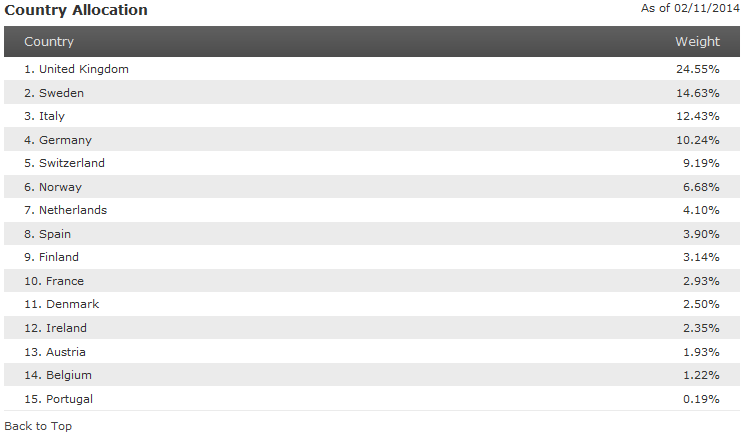
Still, investors need to know exactly what they are getting with DFE, particularly at the country level. While DFE is a small-cap ETF, it is not excessively risk in terms of country exposure. Of the ETF’s top-five country exposures, a group that accounts for over 70% of the fund’s weight, only two – Italy and Germany – are Eurozone members. [Where Some of That Lost EM Cash is Flowing]
With the U.K., Sweden, Germany and Switzerland combing for about 58% of DFE’s weight, there are valuation concerns because of the premium investors pay to gain access to Europe’s steadier hands.
“I do worry about the fund valuation as a whole given its large run up. Per the WisdomTree website, it’s now trading at a 26 P/E and a 3.67 yield. So it’s not cheap like when we bought it,” said Murray. “That said, the trade has seemed to morph from a value play in 2011 to a growth play in 2013 and that may explain the p/e expansion. Investors are seeing the beginnings of European growth and expect more robust earnings growth going forward, so they are willing to pay more today. If Europe is in the early stages of growth, investors are going to look for companies that are leveraged to that .”
There is compensation for DFE’s rising valuation. Murray favors cyclical sectors and sees room for European dividends to grow.
“I think in general dividends still have room to grow. Even with its great price performance, DFE still has a decent yield north of 3%,” he said. “In general we are favoring cyclical sectors both domestically and globally as we think global growth will continue to strengthen regardless of stress in EM.”
Industrials and consumer discretionary names combine for almost 41% of DFE’s weight.
DFE Country Allocation