It was a rough year for investors in a number of multi-country emerging markets exchange traded funds. Slack 2013 performances by some the largest emerging markets ETFs has prompted some optimism about what the new year may have in store for these battered funds.
Investors can get some compensation for betting on an emerging markets rebound in the form of dividend ETFs that are also dedicated plays on developing markets. Examining emerging markets dividend yields can prove to be an especially fruitful exercise following a year in which those yields are elevated.
Research published by WisdomTree in 2013 shows that the average gain for the MSCI Emerging Markets Index was about 17.5%, but following high dividend years that number jumped to 33%. During years in which emerging markets appeared pricy, the return dropped to an average of 1.9%, but most developing markets are currently viewed as inexpensive.
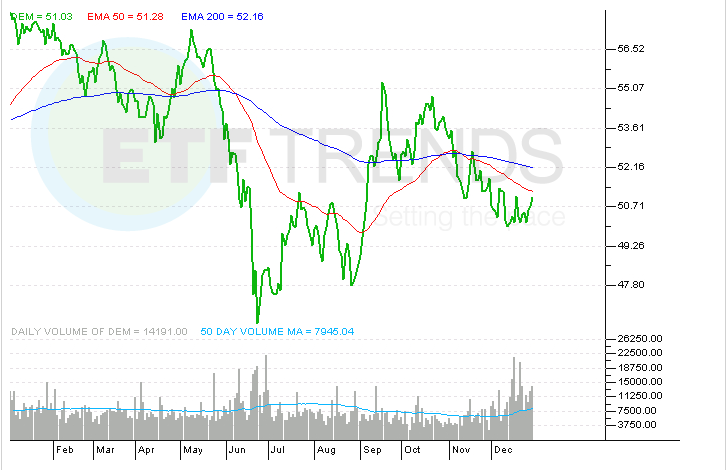
The $4.6 billion WisdomTree Emerging Markets Equity Income Fund (NYSEArca: DEM) is one of the most popular emerging markets dividend ETF options and the fund finished 2013 with a 30-day SEC yield of 3.7%, which tilts toward the high side. Some strategists see upside for the fund in 2014.
“Dividend-paying emerging markets are: 1) An incredible value with P/E ratios in single digits; 2) Starting to trend up. These equities seem to have bottomed in the summer of 2013; 3) Sensitive to institutional buying. If this is the beginning of an upward trend and institutions begin buying these relatively small emerging markets, the upside potential is incredible; 4) The best risk-adjusted returns. Dividend-paying emerging market equities have the potential to provide the best upside returns and the dividends also provide a buffer on the downside risk,” said Vern Sumnicht of Sumnicht & Associates in an interview with Investor’s Business Daily.
Although DEM lost 7% last year, the ETF’s country top country allocations are attractive on at least two levels. Russia and China combine for 37% of DEM’s weight and not only are those two of the least expensive emerging markets, but China is the largest dividend payer and Russia the fastest-growing dividend payer in the WisdomTree Emerging Markets Equity Income Index. [Dividend Growth the Emerging Markets Way]
DEM has competitors to consider as well. The iShares Emerging Markets Dividend ETF (NYSEArca: DVYE) lost 10.4% last year. DVYE has a trailing 12-month yield of almost 4% while Brazil and Taiwan combine for 41% of the fund’s geographic weight.
The EGShares EM Dividend High Income ETF (NYSEArca: EMHD) debuted last August and has a conservative sector bias with utilities, telecom and staples combining for over 41% of the ETF’s weight. Four countries – Brazil, China, South, Africa and Turkey – are 73% of EMHD’s country weight.
EMHD’s underlying index, the FTSE Equal Weighted Emerging All Cap ex Taiwan Diversified Dividend Yield 50 Index, had an index yield of 6.68% at the end of the third quarter, according to issuer data.
WisdomTree Emerging Markets Equity Income Fund
ETF Trends editorial team contributed to this article. Tom Lydon’s clients own shares of DEM.