Emerging Market Interest Rates
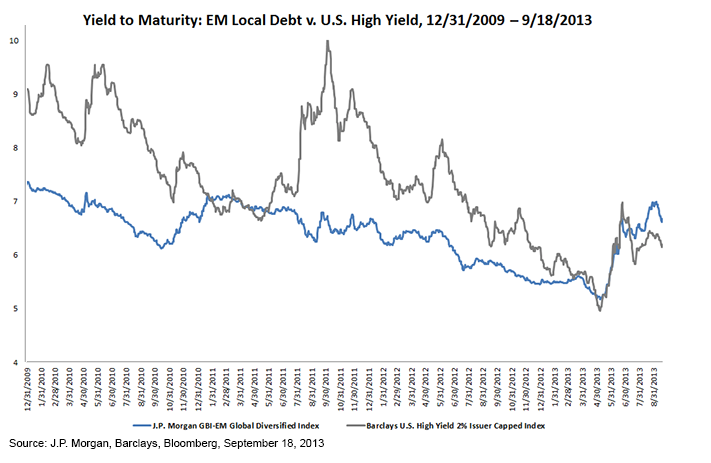
In a similar vein as EM currencies, EM interest rates appear attractive at current levels. As U.S. interest rates touched 3% for the first time in several years, EM rates approached the 7% mark for the first time in three years. At these levels, we believe that emerging markets currently strike an attractive balance between risk and reward. As compared to EM corporate credit, which has exposure to U.S. interest rates, investors in local debt are substituting currency risk (and volatility) plus local interest rate risk. As we noted in a recent blog post, we believe that once the market has acclimated to an eventual Fed tapering, emerging market interest rates will increasingly be influenced by domestic factors as opposed to U.S. policy. However, with rates rising significantly in advance of a Fed tapering that has yet to materialize, we believe EM assets are attractively priced.
At present, the investable universe of emerging market local debt is rated 93% investment grade.4 With some emerging markets being upgraded as recently as May 2013, we believe that only a select few pose a risk of a credit rating downgrade. However, as shown in the graph below, EM local debt was recently offering the largest yield advantage compared to U.S. high yield in history.
Compared to traditional U.S. Treasury Bonds, “opportunistic fixed income,” such as emerging market local debt, has a much different volatility profile. For many investors, investing in bonds with equity-like growth elements is a comparatively new undertaking. In light of recent market developments, we believe that volatility is going to be increasing for nearly all asset classes, including fixed income. However, there is a major distinction between volatility and solvency risk. The recent volatility in the asset class has largely been attributable to movements in emerging market currencies. But unlike past periods of rapid currency depreciation, emerging market economies have taken made significant strides to reduce their external vulnerabilities. At present, an overwhelming number of emerging market countries have significant levels of foreign exchange reserves. These reserves can either be converted from U.S. dollars to support/dampen the volatility of their exchange rates or be used to directly finance their government.
Outlook: Being Paid to Wait
Ultimately, we believe EM local debt is attractively priced at current levels. However, there is always the possibility that market volatility may persist as the U.S. struggles to provide appropriate guidance on the future path of interest rates. At current yields, we believe that EM local debt provides an attractive level of carry that may help dampen future volatility associated with locally denominated fixed income.
Rick Harper is head of fixed income and currency for WisdomTree Asset Management. This post was republished with permission from the WisdomTree blog.
1Source: Bloomberg, September 18, 2013
2Source: J.P. Morgan, Bloomberg, September 18, 2013
3Source: WisdomTree, J.P. Morgan, Bloomberg
4J.P. Morgan, August 31, 2013
