It is particularly interesting to note that the varied optimal allocations are primarily driven by variations in the bond component rather than the equity component. Figure 2 shows the average optimal allocation to bonds (averaged across countries so as to see the overall time pattern) alongside the average excess return to bonds over the same 10-year periods over which optimal weights are computed.
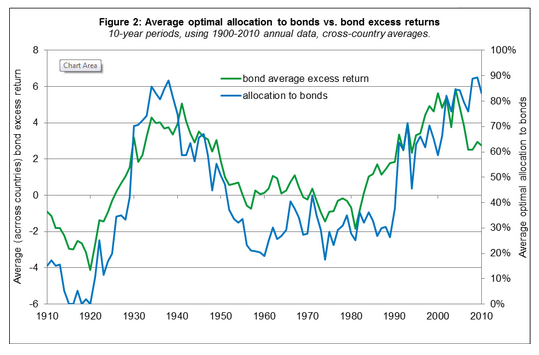
This result may seem counterintuitive given that equities are usually riskier than bonds and are indeed the key driver of the combined portfolio’s overall risk. Investors are accustomed to the expectation that they will be rewarded for the risk that a stock will not perform as imagined. In contrast, however, investors generally view bonds, especially government bonds, as “less risky” or even not risky at all.
Consider the example of the last 20 years. This period has included the so-called “bond bubble,” an era of extremely strong performance by bonds. Many market specialists have now concluded that the strong sell-off of bonds in 2013 marks the end of the bond bubble. Perhaps it has, or perhaps bonds can decline further: the key point is that investors going forward need to have a view of how bonds will perform over the next several years.
But even if the bond bubble had not occurred, investors would need to have a view about bond performance. In fact, it may surprise many investors that they actually need to have a stronger conviction about the performance of bonds than that of equities. Why this is so is reasonably simple. The optimal portfolio allocation is driven by the ratio of risk-adjusted returns of the underlying equities and bonds. On average, equity returns are higher than those of bonds. Given that, every dollar spent on bonds has a return “cost” associated with it that is traded off against the benefit of risk reduction. The upshot is that moving away from 60/40 implicitly requires higher conviction about the performance of the bonds than that of equities.
In short, the analysis suggests that the 60/40 “rule” is indeed a useful starting point for investors considering a basic allocation choice between equities and government bonds, particularly for broad global portfolios where the differences in equity and bond markets across countries are less relevant. It sounds obvious to say that timing an allocation away from 60/40 requires an assumption on the likely future return of the two asset classes. However, it is perhaps less obvious that investors looking to do such timing should be much more focused on the bond component. This is because the optimal allocation will be more sensitive to changes in those views than those of the equity component.
Daniel Morillo, PhD, is the iShares Head of Investment Research.
