“From an investor perspective, the most important thing to bear in mind is that emerging markets gain in terms of capital from accommodative policies, so on that basis Yellen would be the favorite because she is seen as less aggressive in scaling back quantitative easing,” Maarten Jan Bakkum, head of emerging markets strategy at ING investment management, told EuroMoney.
EuroMoney notes that the pace of Fed tapering could directly affect foreign investors’ appetite for emerging markets debt “with Yellen offering EM fixed-income bulls more hope.” Analysts previously argued when Summers appeared to be the frontrunner to replace Ben Bernanke, whose term expires in January 2014, that Summers was likely to ramp-up tapering. That meant the potential for inflicting even more damage on already downtrodden emerging markets assets classes and the ETFs that house them.
“In the months preceding, and immediately after a transition of the Fed chairmanship, interest rates almost always rise,” according to Bank of America Merrill Lynch Research obtained by CNBC.
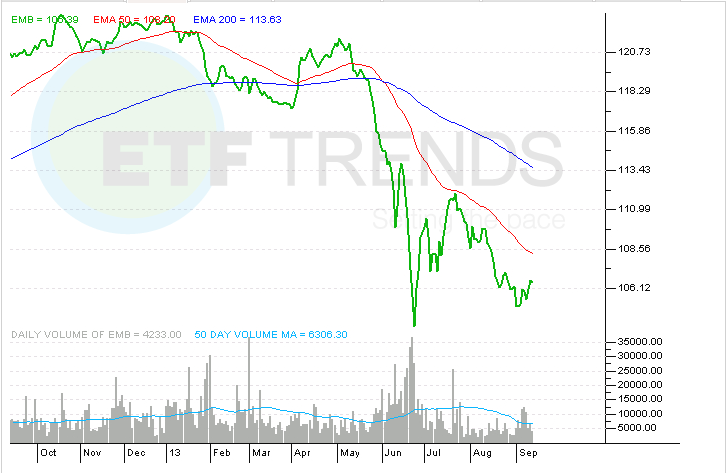
Rising U.S. Treasury yields have already proven problematic for dollar-denominated and local currency emerging markets bonds. The Market Vectors Local Currency EM Bond ETF (NYSEArca: EMLC) is off 5% over the past 90 days, a time frame in which 10-year Treasury yields have spiked.
Although tapering appears to be a matter of “when, not if” at this point, the view that Yellen is not as tapering friendly as Summers could mean a near-term bounce for emerging markets ETFs.
iShares J.P. Morgan USD Emerging Markets Bond ETF
ETF Trends editorial team contributed to this post. Tom Lydon’s clients own shares of EMB.
