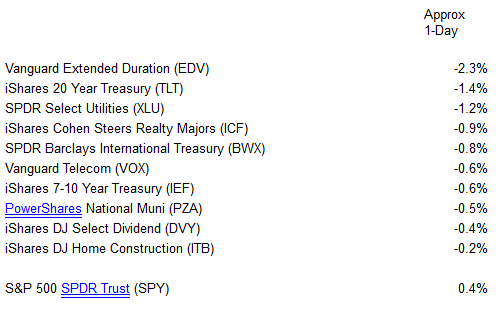
Ben Bernanke and his colleagues must be horrified. Neither the threat of war in the Middle East nor the strong possibility of a drawn-out debt ceiling fight is persuading investors to hold onto their income holdings. Even foreign countries are dumping U.S. treasuries. In effect, the Fed may have wanted to exit quantitative easing (QE) gracefully, but now, the Fed will only contribute to further increases in lending rates if they slow their bond buying significantly.
So they won’t. That’s right… the Fed will continue to talk the talk, while refraining from walking the walk. Either there will be no action whatsoever at the mid-September meeting, or the action will be so minimal that the main talking points will be to emphasize the smallness of the “taper.” They’re purchasing $85 billion per month now. If the Fed takes any serious step towards curbing bond purchases, they risk a genuine stampede to leave rate-sensitive assets, a “double-dip” in housing and the total erosion of the “wealth effect.”
The Fed understands that its monetary policy created a recovery in housing as well as new highs in the stock market. It’s not like Fed members will be comfortable letting longer-term rates get beyond their influence, reversing the wealth effect that came from gains in real estate and investment accounts. Other than the need to remove some of the froth from our collective interest rate addiction, then, it’s difficult to imagine any reason for the Fed to change course. After all, the wealth effect did not genuinely translate into meaningful employment gains and members of the Fed know it. Chairman Bernanke knows that the 7.4% headline unemployment rate would actually be 9.4% when one adjusts for labor force participation data; Bernanke knows that 70% of the new hires in 2013 are part-timers.
In the end, prepare for the 10-year yield to stay below 3%. And if it gets any higher than that, expect QE to continue at the same levels, if not an increase in what the Fed purchases. In fact, do not be surprised if the 10-year works its way back down to 2.5% or 2.25% by year’s end. Granted, it will take a change in mindset about what is safe. Yet institutional money flow could shift on a dime should stock ETFs correct significantly or if a weak employment report gives the Fed opportunity to backtrack.
Gary Gordon is president of Pacific Park Financial, Inc.
