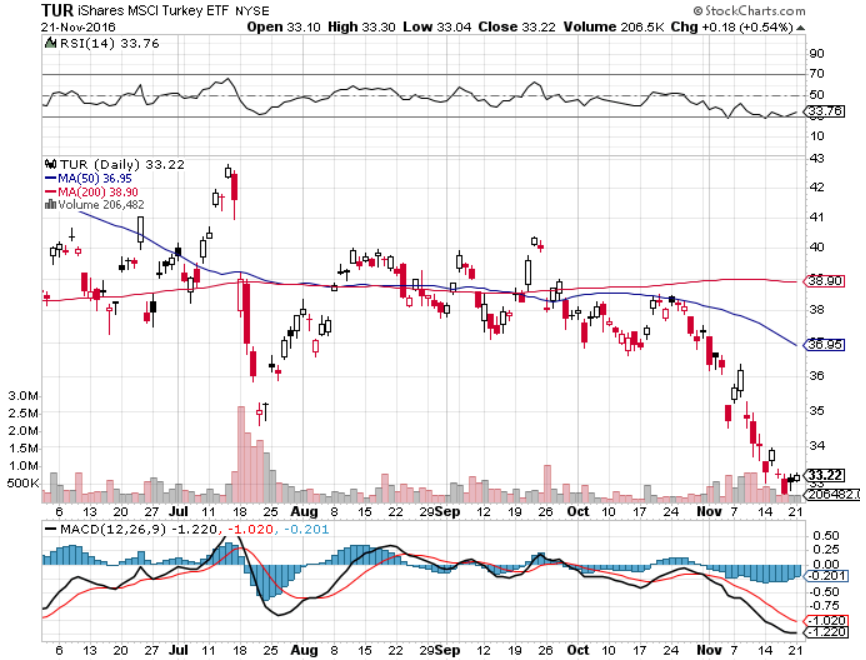
The iShares MSCI Turkey ETF (NYSEArca: TUR) is one emerging markets exchange traded fund that is probably looking forward to 2016 coming to an end.
In what has mostly been mostly a strong year for emerging equities, domestic factors have plagued Turkish stocks. Just this month, TUR has tumbled nearly 14%.
In July, Turkish stocks and TUR tumbled following a failed coup. Turkish markets plummeted on concerns of the implications of the ensuing political turbulence after a failed coup d’etat attempt from the military branch.
In August, Turkey’s central bank lowered interest rates by 25 basis points to 8.75% and said it stands ready to provide liquidity to the country’s banks, if needed, an important factor considering TUR’s weight to financial services stocks is almost 44%, or more than triple the ETF’s second-largest sector allocation.
Following the July coup attempt, S&P Global Ratings cut the country’s sovereign debt rating to BB/B on concerns over an increase in political risk after the failed putsch, reports Bloomberg. Moody’s Investors Service also put a number of companies on review for a downgrade and is reviewing the sovereign for a possible downgrade.
Turkey’s central bank is must-watch theater for investors considering TUR.
“The lira remains on a weakening trend yet at the same time growth displays a slightly larger slowdown than initially anticipated. External conditions are going through a significant shift towards a less friendly equilibrium for emerging market assets, at least in near term. Given such backdrop, the Central Bank of Turkey (CBT) optimally cannot hold onto her previous policy path,” according to a Deutsche Bank note posted by Dimitra DeFotis of Barron’s.
After the coup, the Turkish government declared a three-month state of emergency to in response to the failed coup. The administration is pursuing those accused of being behind the coup and has arrested thousands of army officers, judges, teachers and prosecutors.
Some market participants believe political risk in Turkey exceeds that of other emerging markets, meaning it is too soon for investors to consider supposed bargains in Turkish stocks.
Turkey’s central bank “already gave the first signal for a (temporary) shift in policy stance last month by holding rates on hold … our base case (with 55% probability) for the November Monetary Policy Committee (MPC) meeting is a finalization of the simplification process with a 25 basis-point hike in one-week repo to 7.75% with steady upper and lower bands at 8.25% and 7.25%, supported by a formal signal by policy-makers to do more if necessary –particularly ahead of the December FOMC [U.S. Federal Reserve Open Market Committee] meeting,” according to the Deutsche note seen in Barron’s.
For more stories on the lone Turkey ETF, visit our Turkey category.
iShares MSCI Turkey ETF