Investors seeking to build a diversified investment portfolio should start with a good mix of equities and fixed-income assets. With over 1,900 exchange traded funds on the U.S. markets, picking the right one may be daunting, but investors can still keep things simple.
While investors may enjoy higher returns with an all-equity portfolio, a proper mix of stocks and bonds helps diminish overall risks, writes Mark Hulbert for MarketWatch.
Since 1926, a 60/40 stock and intermediate-term Treasury bond portfolio would have produced an 8.6% annualized return, or 1.4 percentage points lower than the 10% annualized return of an all-stock portfolio. Over the past 20 years, the all-equity portfolio beat the 60/40 portfolio by only 0.7 percentage points.
However, investors typically can’t stomach the volatility of stocks in an all-stock portfolio during a bear market, often dumping positions as losses increase.
“The people who can truly stomach the volatility of a 100% stock portfolio are either catatonic or dead,” Claude Erb, a former fixed-income and commodities manager at mutual-fund firm TCW Group, told MarketWatch.
[related_stories]The 60/40 mix also outperformed during periods of rising rates. From 1966 to 1981 when yields on intermediate-term Treasuries almost tripled from 4.7% to 13.6%, a 60/40 portfolio beat the all-equity portfolio by 0.3 percentage points per year on an annualized basis.
When it comes to the basics, most financial advisors suggest diversified exposure in equities and fixed-income assets that encompass the global markets. Investors can also produce a 60/40 stock and bond mix through as little as three ETF options from various fund providers.
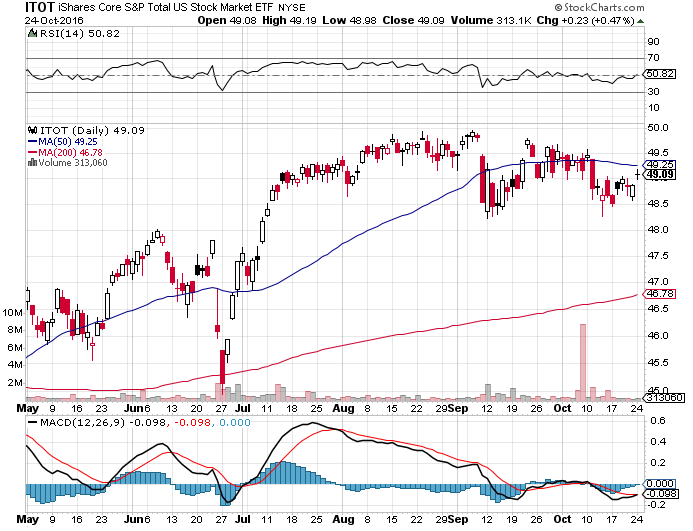
For instance, investors can hold cheap index-based ETFs such as BlackRock’s iShares suite, including iShares Core S&P Total U.S. Stock Market ETF (NYSEArca: ITOT), iShares Core MSCI Total International Stock (NYSEArca: IXUS) and iShares Core U.S. Aggregate Bond ETF (NYSEArca: AGG). ITOT provides exposure to the total U.S. stock market, IXUS includes developed ex-U.S. and emerging market companies. AGG tracks broad U.S. investment-grade debt.
Similarly, investors can utilize the low-cost Vanguard Total Stock Market Index ETF (NYSEArca: VTI), Vanguard Total International Stock ETF (NYSEArca: VXUS) and Vanguard Total Bond Market ETF (NYSEArca: BND). VTI following CRSP index of large-, mid- and small-cap U.S. stocks. VXUS reflects an FTSE index of developed and emerging market countries, excluding U.S. exposure. BND also tracks U.S. investment-grade debt.
Rounding out the top three ETF providers, State Street Global Advisor offers the SPDR Russell 3000 ETF (NYSEArca: THRK), SPDR MSCI ACWI ex-US ETF (NYSEArca: CWI) and SPDR Barclays Aggregate Bond ETF (NYSEArca: BNDS). THRK tries to reflect the broad Russell 3000 Index, which represents approximately 98% of the investable U.S. equity market. CWI follows a similar portfolio as IXUS. BNDS also tracks the benchmark Barclays U.S. Aggregate Index of investment-grade U.S. debt.
For more information on ETFs, visit our ETF 101 category.
iShares Core S&P Total U.S. Stock Market ETF (NYSEArca: ITOT)