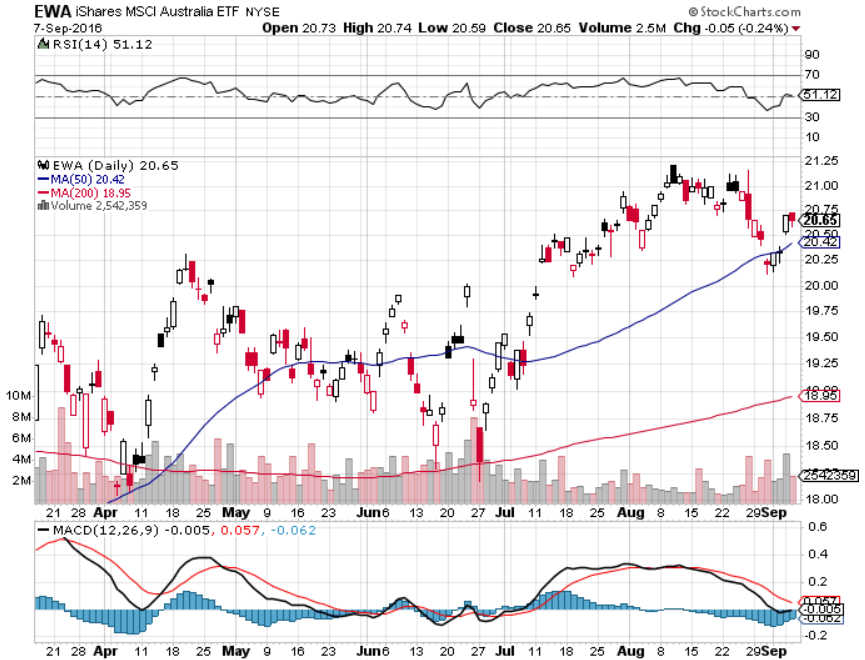
Among developed markets single-country exchange traded funds, the iShares MSCI Australia ETF (NYSEArca: EWA) has been a solid performer this year with a gain of almost 9%. Rebounding commodities prices and an accomodative central bank are boosting Australian equities, EWA and helping the country continue its lengthy streak of not falling into a recession.
The Australian dollar could be increasingly vulnerable as the monetary policies of the Fed and the Reserve Bank of Australia continue diverging. RBA recently cut Australia’s benchmark interest rates to a record low. However, EWA, which is not a currency hedged ETF, has performed well in the face of RBA rate cuts.
Australia’s benchmark interest rate of 1.75 percent is a record low for the country, but well above most other developed markets, indicating there is room for further downside.
Related: Aussie Dollar ETF Plunges as Reserve Bank Cuts Rates
The looser monetary policy could support the economy but weigh on the AUD. Consequently, investors may track the markets through currency-hedged ETFs that try to mitigate the negative effects of a weakening Aussie, including the iShares Currency Hedged MSCI Australia ETF (NYSEArca: HAUD) and Deutsche X-trackers MSCI Australia Hedged Equity ETF (NYSEArca: DBAU).
[related_stories]“Since the second half of 1991, the country’s economy has weathered global recessions, stock market crashes, political turmoil, high-profile wars overseason, and much more. Yet it’s still come out smelling like a rose,” according to ETF Daily News. “Along with China, Australia’s economic growth has been unparalleled over the past two-and-a-half decades. Its secret boils down to a combination of strong natural resources and solid leadership.”
The SPDR MSCI Australia Quality Mix ETF (NYSEArca: QAUS) emphasizes the quality factor, which captures excess returns to stocks that are characterized by low debt, stable earnings growth and other ‘quality’ metrics. Lastly, the First Trust Australia AlphaDEX Fund (NYSEArca: FAUS) selects Australian companies based on growth factors including 3-, 6- and 12-month price appreciation, sales to price and one year sales growth, along with value factors including book value to price, cash flow to price and return on assets.
Related: Down Under Opportunity
Thanks to comparatively high interest rates, Australia ETFs like EWA sport enticing dividend yields, which can help investors generate current income while expanding the international portions of their portfolios. EWA has a trailing 12-month dividend yield of 6%, or nearly triple the comparable yield on the S&P 500.
“The natural resource sector has faltered lately among sharply lower commodity prices, but the country’s central bank has responded by cutting rates to increase inflation. In turn, inflation has boosted exports, helped increase tourism, and spurred demand in the housing market,” reports ETF Daily News.
Click here to read more ETF news, strategy and commentary on ETF Trends.
iShares MSCI Australia ETF