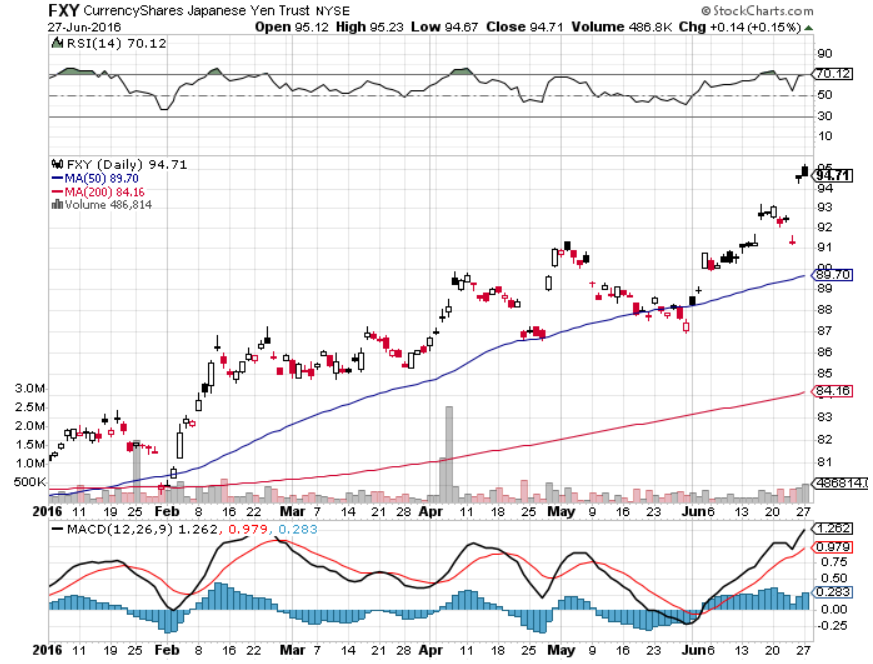
Up nearly 17.5% year-to-date, the CurrencyShares Japanese Yen Trust (NYSEArca: FXY) is undoubtedly one of this year’s best-performing foreign currency exchange traded funds.
The yen and FXY have been bolstered by investors’ thirst this year safe-haven assets, a desire that appears to be growing stronger in the wake of Great Britain’s decision, revealed late last week, to depart the European Union (EU). That is to say betting against the yen has not only been difficult, but wrong.
Economists have largely expected the BOJ to take aggressive action, especially since BOJ Gov. Haruhiko Kuroda has repeatedly promised to take action “without hesitation” if the central bank’s 2% inflation target is in danger. The Japanese central bank also took no action in April when expectations for further loosening were high.
Related: 35 A+ Currency ETFs to Track Global Forex Moves
Despite the yen’s strength and an environment that is clearly conducive to less risky assets, some market participants believe FXY and the Japanese currency are due to decline.
[related_stories]“Another good reason to short the yen is that a weak yen is exactly what the BOJ wants in order to stimulate exports. The United States has signaled that it will not look kindly on selling intervention by the BOJ to depress the yen against the U.S. dollar. While the U.S. has largely ignored yen weakness in recent years, it appears to be paying more attention to the issue, believing that a continued weak yen may have a depressing effect on the U.S. economy. As a result, the U.S. has openly warned the BOJ against intervention to weaken the yen,” according to Investopedia.
The ongoing yen strength could continue to weigh on Japanese equities. For instance, electronic parts maker Murata Manufacturing Co. lost 13% following its projects for a dip in earnings in the fiscal year, citing a stronger currency, lower product selling prices, increased fixed costs and higher R&D expenses.
More international investors have piled in to the relatively attractive yields in U.S. government debt as foreign central bank policies have pushed international government yields to near zero or negative in some cases like Japan. However, that scenario merely serves to underscore the intensity with which investors are flocking to the yen as a safe-haven play.
Related: Are Dollar ETFs Ready to Rally?
“After several years of QE worldwide, the general consensus is that easing tends to depress the value of a country’s currency. Mark Matthews, the head of Asia research for the Swiss private banking firm, Julius Baer Group Ltd. (VTX: BAER), stated in an April 2016 interview that more QE is one of the BOJ’s few remaining options to stimulate an economy still showing poor growth and falling well short of the BOJ’s 2% inflation target,” reports Investopedia.
For more information on the yen currency, visit our Japanese yen category.
CurrencyShares Japanese Yen Trust