Note: This article was written by Patrick Luby, complements of VanEck.
Using exchange traded funds (ETFs) to access the muni market can make it easier to maintain an appropriate and more comfortable level of risk in one’s “core” allocation than using individual muni bonds. Muni ETFs may also open up possibilities to take on incremental risk in a more liquid and broadly diversified way.
Most portfolio strategists recommend that the majority of a fixed income allocation consist of exposure to investment grade bonds, with exposure to high yield (non-investment grade bonds) limited to a subset of one’s fixed income allocation.
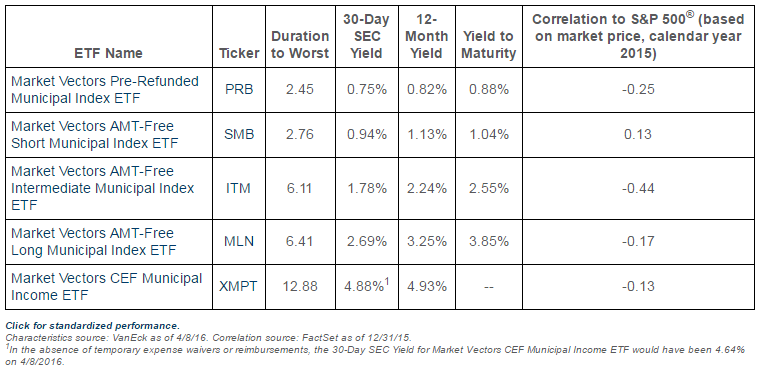
Investors may find using duration a more helpful guide to interest rate risk than maturity date. The tables below illustrate the durations of VanEck muni ETFs, as well as correlations, as a reminder that the benefits of diversification can vary, depending on the objectives and characteristics of each ETF.
The five ETFs in this first table may be a good way to start or replace some core fixed income exposure.
VanEck Muni ETFs for the Core
Investors seeking incremental income or those who are comfortable with lower credit quality may wish to consider supplementing their core holdings by using SHYD, HYD, or XMPT. Using an ETF for the higher risk portion of one’s fixed income allocation provides very broad diversification as well as intra-day liquidity. However, it’s important to remember that diversification alone does not necessarily assure a profit or a loss.
VanEck Muni ETFs for Incremental Income
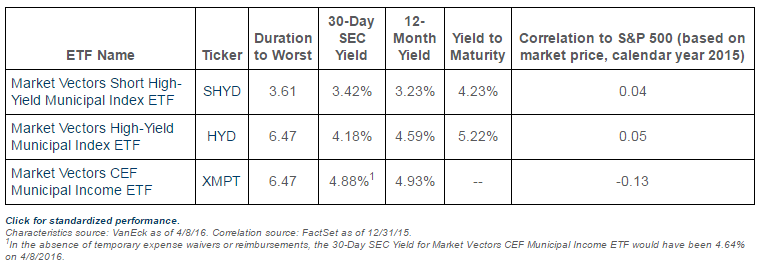
XMPT is included in both tables due to its unusual characteristics; because the leveraged closed-end funds in which it invests are generally over-collateralized, exposure to credit risk may be greatly reduced. However, because of the leverage employed by the underlying funds, there is greater interest rate risk. Prudent investors might use it for a portion of the long duration part of the core of their portfolios or to supplement or supplant their high yield allocation.
Conclusion
Because of the changes and challenges in the municipal bond market and the exchange-traded liquidity available via ETFs, even experienced investors may find that they can more easily tailor a diversified portfolio with a mix of muni ETFs than with individual bonds.
[related_stories]Post Disclosure
Patrick Luby is a Fixed Income Portfolio Strategy Specialist and the author of www.IncomeInvestorPerspectives.com. He has been helping many of the industry’s best advisors and their investor clients understand and navigate the municipal bond market since the weekly Bond Buyer Municipal Bond Index was at 9.48%.
This is not a recommendation to buy, sell, or hold any of the securities or strategies mentioned. The author does not provide investment, tax, legal, or accounting advice. Investors should consult with their own advisor and fully understand their own situation when considering changes to their strategy, tactics, or individual investments.