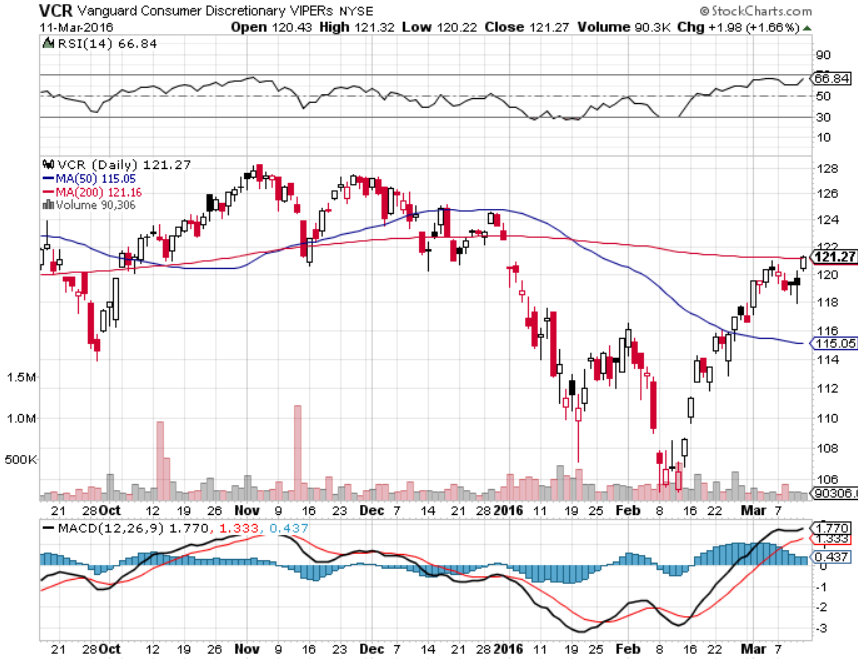
- Consumer discretionary sector has been on a torrid pace since start of current bull market
- More affluent consumers are showing strong sentiment while lower- and middle-income consumers are taking a more middle viewpoint
- Thesis is Federal Reserve will not raise interest rates until it is entirely confident the U.S. economy can withstand higher borrowing costs
The consumer discretionary sector, the fourth-largest sector weight in the S&P 500, has been on a torrid pace since the start of the current bull market. Fortunately, there are plenty of exchange traded funds with which to play that theme.
Consumers remain confident and optimistic. Some analysts believe that more affluent consumers are showing very strong sentiment while lower- and middle-income consumers are taking a more middle viewpoint.
The Vanguard Consumer Discretionary (NYSEArca: VCR) is one of the most familiar names among consumer discretionary ETFs. It is also the least expensive with an annual expense ratio of just 0.1%, or $10 per $10,000 invested. Big-name holdings in VCR include Amazon (NASDAQ: AMZN), McDonald’s (NYSE: MCD), Target (NYSE: TGT) and Time Warner (NYSE: TWX).
S&P Capital IQ currently holds a market Overweight rating on the consumer discretionary sector. It might seem counter-intuitive, but consumer discretionary stocks and the corresponding exchange traded funds might respond more positively to higher interest rates than some investors are giving the group credit for. VCR includes a more diversified take on the sector with 385 component holdings.
The thesis is the Federal Reserve will not raise interest rates until it is entirely confident the U.S. economy can withstand higher borrowing costs. Said another way, the Fed boosting rates could be seen as a sign the U.S. economy is in good shape and that could spark gains for ETFs such as VCR.
With the U.S. dollar strengthening, currency risk is also a concern for many investors. However, foreign currencies and global consumer spending do not have a major effect on U.S. consumer discretionary sector, according to Morningstar. [Discretionary ETFs for a Growing Economy]
VCR “seeks to track the performance of the MSCI U.S. Investable Market Index (IMI)/Consumer Discretionary 25/50, its benchmark index. Its investment objective is to employ a fully replicating approach. Since the fund implements that approach, it has an extremely low tracking error of 0.05. VCR invests nearly all of its assets in common stocks comprising the index, with the same allocation as the weighting in the index,” according to Investopedia.
Other factors are at play for discretionary ETFs, including rising wages and the higher minimum wage. including the rising minimum wage. Meanwhile, a growing segment of America is calling for higher minimum wages across the government after years of stalled efforts. The national minimum wage has been set at $7.25 per hour since 2009, and changes would require the support of the Republican-controlled Congress.
A number of research has pointed to improved economic conditions from higher wages. For instance, in a 2011 study by the Chicago Federal Reserve, the author found that for ever dollar increase in minimum wage, a worker’s household added $2,800 in new consumer spending over the following year.
VCR “has a P/E ratio of 22.1, which is higher than that of the iShares U.S. Consumer Services ETF. Its P/B ratio of 4.3 is in line with that of the iShares U.S. Consumer Services ETF. The Vanguard Consumer Discretionary ETF’s top five holdings are identical to those of the iShares U.S. Consumer Services ETF,” according to Investopedia.
Vanguard Consumer Discretionary