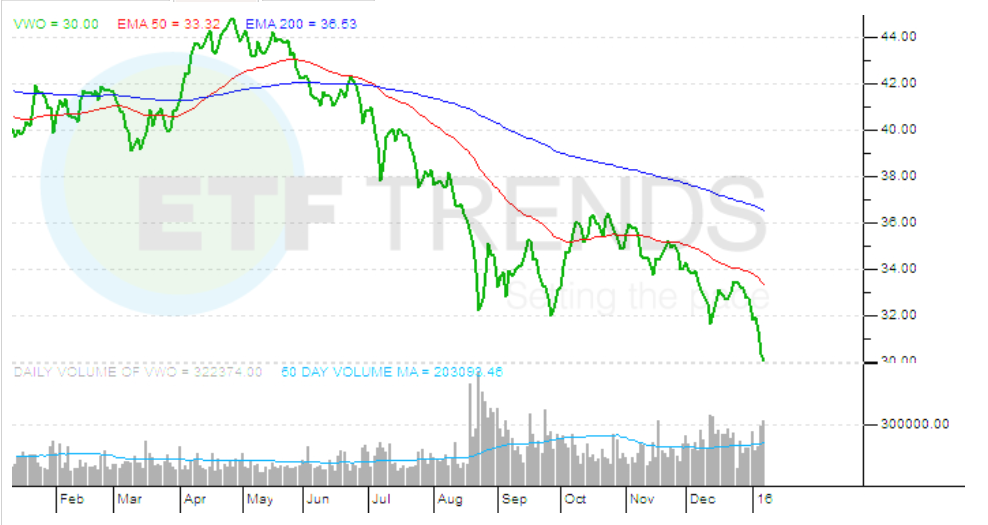
The Vanguard FTSE Emerging Markets ETF (NYSEArca: VWO) and the iShares MSCI Emerging Markets ETF (NYSEArca: EEM), two largest emerging markets exchange traded funds by assets, are still saddled with year-to-date losses of more than 3%. These titans of emerging markets ETFs along with rival funds and single-country assets remain vulnerable to outflows.
Some fund managers believe it will be a while before emerging markets stocks recover in earnest. Investors pulled out of riskier emerging markets as data showed growth from China’s economy slowed, commodity prices fell and the Federal Reserve signaled an interest rate hike this year.
The China slowdown is fueling the lower commodity prices and lower outlook for other major emerging economies. Moreover, rising borrowing costs, a stronger dollar and rising corporate debt loads, with the International Monetary Fund warning of corporate defaults, are adding to volatility. [Area Emerging Market ETF Investors Must Monitor]
“Investors withdrew $272 million from U.S. exchange traded funds that buy emerging markets stocks and bonds last week, bringing January’s losses to more than $4 billion, the most since August,” reports Kenneth Kohn for Bloomberg. “Redemptions from emerging-market ETFs that invest across developing nations as well as those that target specific countries totaled $4.13 billion, compared with inflows of $1.36 billion in December, according to data compiled by Bloomberg. Last month’s declines were the worst since August, when they reached $6.13 billion.”
Currently, no emerging markets ETFs are among this year’s 10 worst ETFs in terms of outflows. However, only one ETF lost more assets last year than EEM and only three, including EEM, bled more money than VWO.
Some market observers acknowledge emerging markets appear inexpensive because earnings growth is contracting with little sign of rebounding in the near-term.
EEM “has seen an even steeper selloff than U.S. stocks this year, falling more than 11 percent in the first two weeks of 2016. However, Gordon sees the emerging markets fund falling even farther, to the $20 level, which would be another 30 percent drop from where the ETF closed on Friday,” according to CNBC.
India, Asia’s third-largest economy, is widely believed to be one of the sturdier emerging markets, but U.S.-listed ETFs tracking Indian stocks have struggled over the past year. Over the short-term, India has benefited from cheap energy prices as the country is one of the largest importers of crude oil. Looking further out, economic reforms, including more business-friendly and growth-oriented policies, could help support growth over the medium-term.
“Last week’s outflows slowed from $1.2 billion in the previous period, the data show. Stock funds lost $209.2 million and bond funds declined by $62.8 million. The MSCI Emerging Markets Index advanced 4.5 percent in the week, paring January’s decline to 6.5 percent,” according to Bloomberg.
Vanguard FTSE Emerging Markets ETF
Tom Lydon’s clients own shares of EEM.