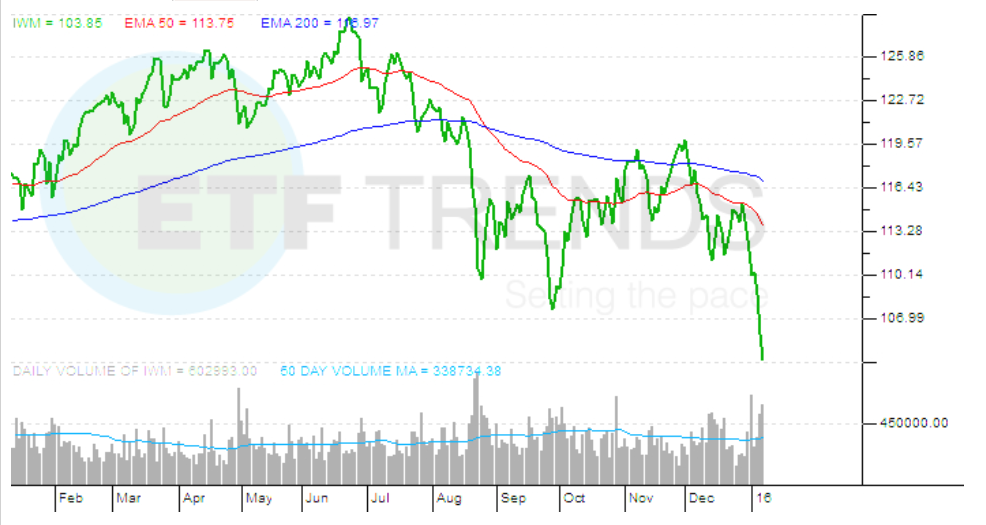
Small-cap equities and the related exchange traded funds, such as the iShares Russell 2000 ETF (NYSEArca: IWM), have struggled to start the new year. For its part, IWM, the largest ETF tracking smaller stocks, is more than 8% over the past month.
Some technical analysts believe small-cap ETFs and stocks need to get their respect acts together soon or risk a lengthy period of disappointing performances.
Smaller companies are a play on the domestic economy. While previous economic reports have been less than appealing, economists expect the gross domestic product to accelerate in the second half of the year. [Mid-, Small-Cap ETFs to Focus on U.S. Growth]
“On the weekly chart, the first downward wave [i]of the expected five-wave sequence probably finished in late September 2015. The upward retracement met our expectations for wave [ii], and now price appears to be declining in wave [iii]. We believe the third wave of the Russell 2000 decline can continue for several more weeks, which suggests that traders who are already in short positions with respect to the fund or the index might simply remain in those positions (while also taking steps to lock in profits and mange risk),” according to See It Market.
S&P Capital IQ Equity Strategist Sam Stovall pointed out that small-caps have advanced an average 10.9% in Presidential election years since 1980, or more than double the 4.2% gain for the S&P 500. Investors may be exposed to potentially attractive growth rates in the more nimble small-cap category. Small-caps are expected to experience an earnings growth rate of 59%, compared to 8% for large-caps.
If the U.S. economy continues to expand, smaller companies may continue to outperform. In contrast, large-cap benchmarks, like the S&P 500, include more slow-growing multinationals, which may have seen weakened overseas revenue streams after the U.S. dollar strengthened.
“The bounce up from the price low of mid-January 2016 occurred in about the right place for a small fourth wave to begin, still inside the larger downward wave [iii]of the Russell 2000 decline. Now that the correction in both IWM is approaching standard retracement areas near 102.74-103.03 and perhaps higher near 105.56, it may be time for faster traders to start looking again for short entries. Initial downward price targets for wave (v) of [iii]include 94.13, 91.61, and 88.49, which suggests that anyone trading down toward those levels consider exiting in whole or in part as price reaches those general areas within the Russell 2000 decline,” adds See It Market.
iShares Russell 2000 ETF
Tom Lydon’s clients own shares of IWM.