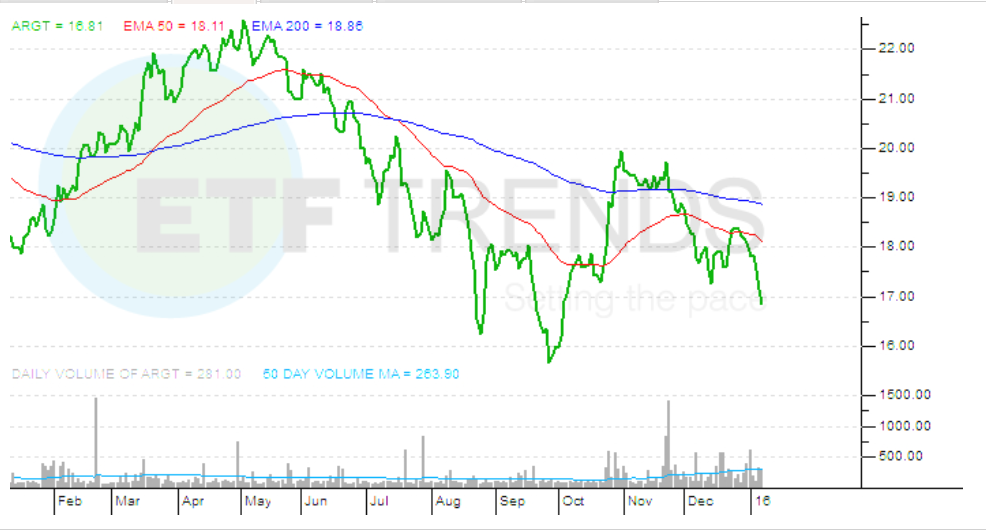
The Global X MSCI Argentina ETF (NYSEArca: ARGT) is down more than 9% this year, a showing that potentially belies equity market opportunity in South America’s third-largest economy.
Market observers seem inclined to wager that Argentina’s newly elected Mauricio Macri could mean big changes in the economy after years of tepid growth. The pro-market Macri has pledged to quickly reverse much of the previous heavy-handed economic policies and open up the economy that has been posting back-to-back years of near stagnate growth, Bloomberg reports.
In the 14 years after Argentina carried out the world’s largest default, the Nestor Kirchner and Cristina Kirchner implemented a number of outdated policies, including a heavily regulated foreign-exchange system, seizure of privately-owned assets and under-reported inflation.
“Argentine companies’ growth has been limited to the internal capital they can tap. All that is about to change as the new Argentine government reaches payment agreements with bond-investor “holdouts” — the U.S. hedge funds and others who hold claims on defaulted Argentine debt. Argentina’s government — and companies — are about to gain access to global capital markets, and that should favor equities,” reports Dimitra DeFotis for Barron’s, citing Raymond James.
However, Macri has his work cut out for him. Foreign reserves are at nine-year lows. Prices on the country’s commodity exports are down. The budget deficit is at its widest in three decades. Inflation is running at an annual pace of over 20%.
Analysts are warning that things could initially grow worse as the new president implements tough measures, such as cuts to the budget and devaluation of the peso, that could further weigh on consumers. Oxford Economics projects gross domestic product could contract over the next two years before returning to growth of more than 5% by 2019.
“Argentina’s domestic credit-to-GDP is currently less than 20%, well below the regional average of close to 45%. In addition, excluding household indebtedness (via consumer credit, car loans and/or mortgages), the corporate domestic credit-to-GDP falls to around 10%. In the case of the sample of companies under analysis, the net debt-to-EBITDA ratio reaches only ~1.5x, while, in the case of financial institutions, the loans-to-equity ratio is less than 5x. In light of this, in general terms, Argentine firms could increase their leverage to finance investments – and drive faster earnings growth – without creating any material impact on their repayment capacity or credit quality,” according to the Raymond James note posted by Barron’s.
Global X MSCI Argentina ETF