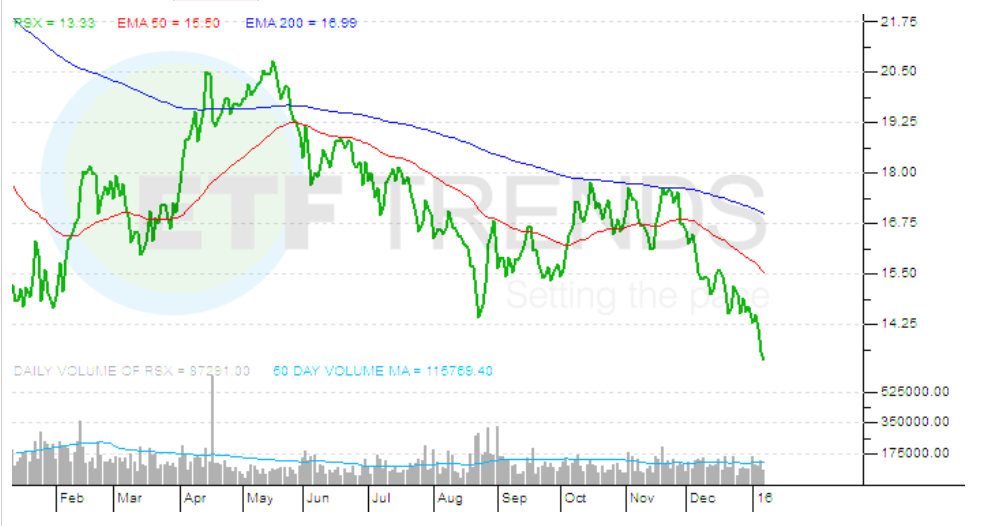
With oil prices continuing to probe 12-year lows, the Market Vectors Russia ETF (NYSEArca: RSX) fell nearly 3% yesterday to a new 52-week low. Russia country-specific ETFs are usually sensitive to changes in oil prices because the funds allocate significant portions of their weight to energy stocks and the sector accounts for a massive percentage of the total market value of Russian equity markets.
In addition to slumping oil prices, Russian stocks and ETFs such as RSX are also being hampered by the plunging ruble. During Russia’s trading session Wednesday, the ruble slumped to an all-time low against the U.S. dollar, prompting some market observers to up criticism of the country’s central bank for doing more to defend the currency.
“The Russian Central Bank came in for criticism from Sergei Glazyev, an economist and aide to Putin. He said the bank’s refusal to support the ruble “causes surprise and laughter around the world,” the Tass news agency reported,” according to the Associated Press.
The combination of a weakening energy outlook and the depreciating currencies are dragging on the ETFs that cover the major exporting countries. In June, the Bank of Russia cut its one-week auction to 11.5% from 12.5%. Just eight months ago, Russia’s central bank boosted its benchmark interest rate to 17% from 10.5%. However, rising inflation there is seen as a hurdle to additional easing.
On a technical basis, some traders could see opportunity in RSX because the ETF’s recent slide has made it deeply oversold.
“A 15 percent decline in the fund’s price through Friday pushed its 14-day relative strength index, a velocity measure used by technical analysts to determine whether an equity is oversold, below 30. Such a low RSI reading tend not to last very long, and that gauge crossing above 30 from below, as it did with the Russia ETF, is considered a bullish signal,” reports Elena Popina for Bloomberg.
Economic bservers are remain cautious over the market outlook. While President Vladimir Putin and other Russian politicians argue that the worst is over, the economy is expected to remain in a recession for the year. Russia’s GDP is expected to contract again this year, extending what is becoming a lengthy recession.
Market Vectors Russia ETF