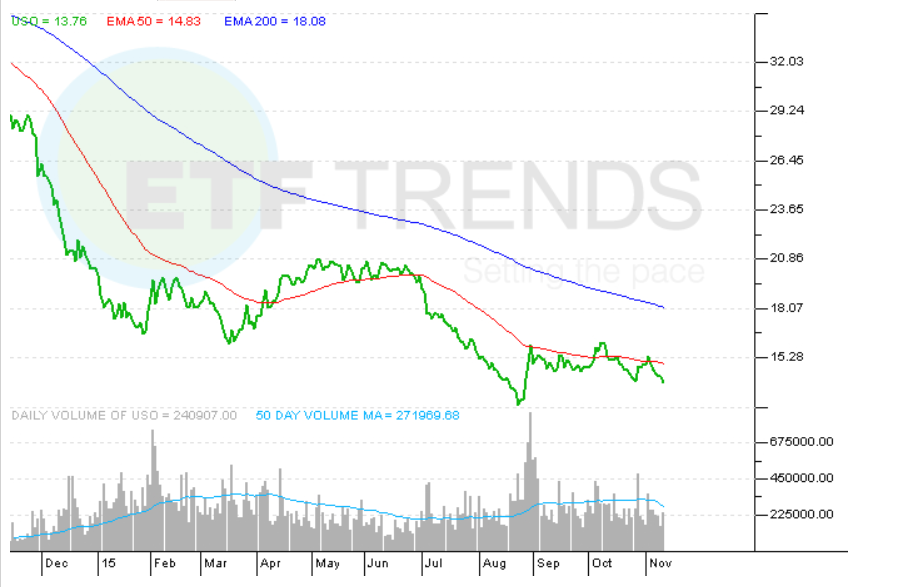
On Monday, the United States Oil Fund (NYSEArca: USO), which tracks West Texas Intermediate crude oil futures, declined 5.9% and the United States Brent Oil Fund (NYSEArca: BNO), which tracks Brent crude oil futures, decreased 5.7%. Both exchange traded products slumped to all-time lows Organization of Petroleum Exporting Countries decided against curbing production to prop up prices.
Crude oil prices fell to their lowest levels since early 2009 after OPEC’s meeting Friday ended without an agreement to lower production, Reuters reports. OPEC has been fueling a global supply glut in an attempt to maintain market share and squeeze out high-cost oil producers, such as the nascent shale industry in the U.S.
OPEC has kept up production to pressure high-cost rivals, such as the developing U.S. shale oil producers. The International Energy Agency expects it will take several years before OPEC can effectively price out high-cost producers. [Oil ETFs Face World-Record Supply Glut]
Now, some technical analysts are identifying $35 per barrel as a key support area for crude futures going forward.
“Crude bottomed in January 2009 at $33.20 but spent the better part of December 2008 to March 2009 in a range between $35 and $50. I would assign the bottom of that range as support now, too, but would not suggest buying the instant the market got there. There is too much emotion built in the energy markets from industry losses and other fundamentals that have lead to predictions oil prices will stay low for years,” reports Michael Kahn for Barron’s.
There are reasons for investors to be cautious with volatile energy ETFs. Moreover, if oil prices falls to new lows and the shale industry is unable to turn a profit, the highly leveraged industry may find it harder to repay debt obligations. The IEA said the “massive cushion has inflated” on record supplies from Iraq, Russia and Saudi Arabia.
Investors can utilize a number of inverse or bearish ETF options to hedge against further declining energy prices. For instance, the United States Short Oil (NYSEArca: DNO) tracks the opposite moves of the West Texas Intermediate crude oil futures, and the DB Crude Oil Short ETN (NYSEArca: SZO) also tracks the simple inverse of oil. [Leveraged ETFs Are Popular Plays Among Swing Traders]
“The good news for energy bulls is that there is a solid technical reason not to expect too much of an overshoot of the $35 support. On a monthly chart, crude oil is more oversold now that it was in 2008. And on a weekly chart, momentum readings, while still weak, are actually getting ‘less weak,’” adds Barron’s.
United States Oil Fund