The East Coast is finally expected to feel a colder winter, heating up natural gas-related exchange traded funds, with natgas futures posting their largest surge in almost two months after dipping toward 16-year lows.
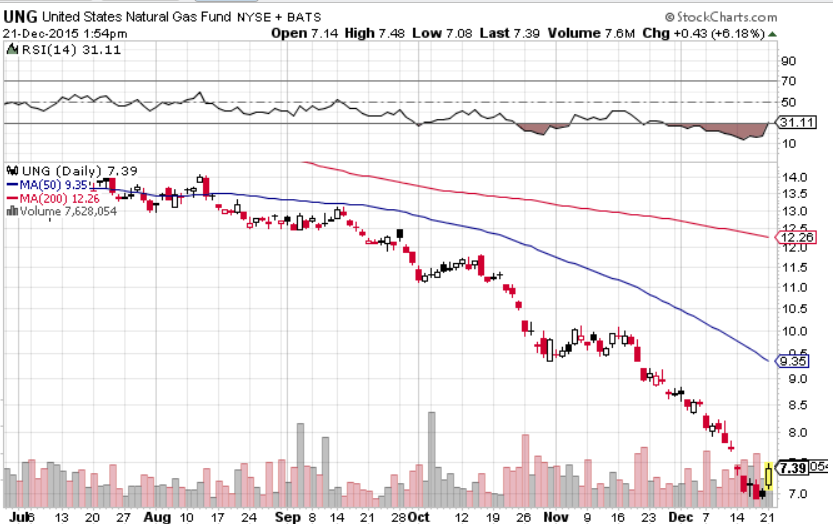
On Monday, the United States Natural Gas Fund (NYSEArca: UNG) rose 6.2% and the iPath Bloomberg Natural Gas Subindex Total Return ETN (NYSEArca: GAZ) gained 13.0%. Over the past year, UNG declined 62.9% and GAZ decreased 75.5%.
Meanwhile, the three-times leveraged-long VelocityShares 3x Long Natural Gas ETN (NYSEArca: UGAZ) surged 17.8% Monday while the ProShares Ultra Bloomberg Natural Gas (NYSEArca: BOIL), which takes the two times or 200% daily performance of natural gas, jumped 9.7%.
Nymex natural gas futures were 8.8% higher Monday, trading around $1.92 per million British thermal units. Natgas futures dipped to $1.755 mmBtu last week.
Natural gas was warming up Monday as a cold weather front moved across the East, raising speculation on heating demand, reports Timothy Puko for the Wall Street Journal. Almost half of U.S. homes utilize natural gas for heating.
Forecasts call for temperatures closer to normal for this time of year across the East and below normal in the Rockies through the end of December.
Consequently, the sudden turn in weather forecasts has forced bearish traders to close out positions, contributing to the sudden surge in futures. Since August, money managers have had almost two bearish positions on gas for every one bullish position.
Natural gas prices have been weakening on a stronger-than-expected El Nino weather pattern, along with surging energy production from the nascent U.S. shale oil industry. According to the U.S. National Oceanic and Atmospheric Administration, heating demand has been 23% lower-than-normal in the current heating season due to above average temperatures across the continental U.S., reports John Kemp for Reuters. [Natural Gas ETFs at New Lows as Inventories Hit New Highs]
NOAA also predicts the warmer temperatures to last through early 2016, pointing to an El Nino phenomenon that ranks among the top three strongest since 1950.
“While the warmer-than-average ocean waters are likely reaching their peak about now, they will remain a huge source of warmth for the next several months to drive the main impacts on temperature and rain/snow over North America, which typically follow the peak. The main impacts season is December-March,” according to NOAA. “Most models indicate that a strong El Nino will continue through the northern hemisphere winter 2015/16.”
United States Natural Gas Fund
For more information on the natgas market, visit our natural gas category.
Max Chen contributed to this article.