U.S. stocks slid Monday as global growth concerns and prospects of a Federal Reserve December rate hike dragged on the equities, fueling market uncertainty and CBOE Volatility Index, or VIX, related exchange traded funds.
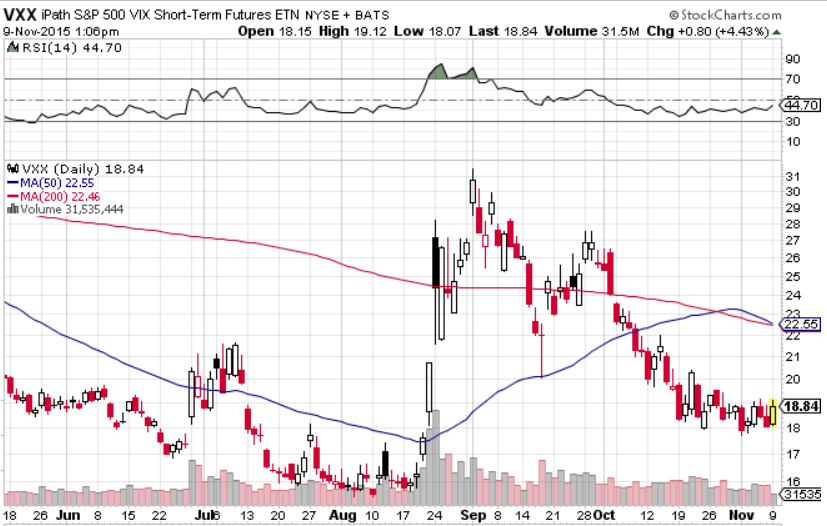
On Monday, the iPath S&P 500 VIX Short Term Futures ETN (NYSEArca: VXX) jumped 4.4%, ProShares VIX Short-Term Futures ETF (NYSEArca: VIXY) rose 4.3% and AccuShares Spot CBOE VIX Up Shares (NasdaqGM: VXUP) advanced 6.1%.
Meanwhile, the VIX surged 14.3% to 16.4, breaking back above its 200-day simple moving average, while the S&P 500 was down 1.2% to 2073.8. The VIX tracks the implied volatility of S&P 500 index options, is widely used as a measure of market risk and typically rises as uncertainty spikes or the equities markets tank.
The current tick in volatility is a result of a broad market selloff, with the 10 major S&P sectors in the red. The markets retreated after China, one of the U.S.’s largest trade partners, revealed a decline in exports and imports in October and the Organization for Economic Co-operation and Development cut the emerging country’s 2015 global growth forecast again, reports Abhiram Nandakumar for Reuters.
While U.S. stock markets have powered through global economic concerns in recent weeks on better-than-expected earnings results and a strengthening domestic economy, the weakness on Monday may be a trigger for traders to engage in some profit taking.
“We’ve had a rally up and I think we’re just about done for now, at least for the next couple of weeks,” Gary Kaltbaum, president of Kaltbaum & Associates, told Reuters. “To me, it’s more that the market is petering out here after rallying.”
Additionally, investors may be turning more cautious after the unexpected strong jobs report, which has bolstered the case for a December rate hike, MarketWatch reports.
“Markets cannot escape the gravitational pull of the Fed, so the stocks are under pressure because of the fact that we may see interest rates rise in December,” Kim Forrest, senior analyst and portfolio manager at Fort Pitt Capital Group, told MarketWatch.
While the markets were experiencing heightened uncertainty Monday, the frequency of volatile days may be diminishing. October usually experiences the most volatility with the VIX peaking during 5 years in the month, and the Volatility Index typically troughs over December as it has during the 7 precious years, Nicholas Colas, Chief Market Strategist at ConvergEx, said in a research note.
Over the past half-century, there have only been plus 1% an d minus 1% stock market moves on average of 2.4 days each in November, and 2.3 up days and 1.9 down days on average in December.
“There are a few potential days left for 1% returns either way, enough to determine whether the S&P 500 finishes in positive territory for the year as it’s up 2% year-to-date,” Colas said. “December’s Federal Reserve meeting could rile the market, but overall, expect gradual returns this month and next as opposed to the wide swings of the past few.”
iPath S&P 500 VIX Short Term Futures ETN
For more information on the CBOE Volatility Index, visit our VIX category.
Max Chen contributed to this article.