Investor hopes for a quickening expansion in the Eurozone and regional-related exchange traded funds were tempered Friday after worse-than-expected economic growth numbers.
On Friday, the iShares MSCI EMU ETF (NYSEArca: EZU) was down 0.7% and the SPDR EURO STOXX 50 (NYSEArca: FEZ) was 0.8% lower. The two ETFs both focus on Eurozone countries.
The CurrencyShares Euro Currency Trust (NYSEArca: FXE) also dropped 0.7% Friday as the euro currency fell 0.7% to $1.0734.
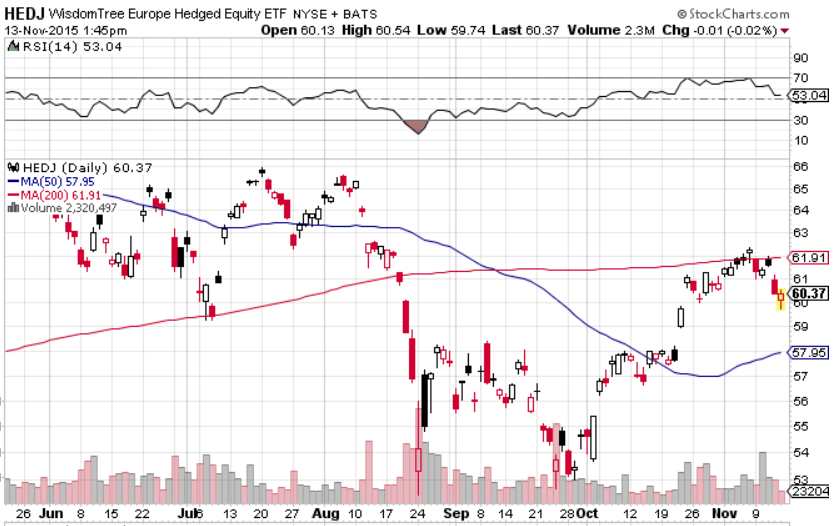
Meanwhile, euro-currency hedged ETFs, which diminish the negative effects of a stronger dollar or weaker euro currency, outpaced other Europe ETFs as the falling euro helped push the hedged version ahead. On Friday, the Deutsche X-trackers MSCI EMU Hedged Equity ETF (NYSEArca: DBEZ) was unchanged, iShares Currency Hedged MSCI EMU ETF (NYSEArca: HEZU) was up 0.1% and WisdomTree Europe Hedged Equity Fund (NYSEArca: HEDJ) was flat.
Dragging on Eurozone stocks Friday, euro-area gross domestic product in the third quarter slowed to just 0.3%, with modest growth out of German, France and Italy while Portugal stagnates and Finland’s decline continues, reports Graeme Wearden for The Guardian.
“There are still ongoing concerns about slowing economic growth, and there are other worries about more QE in Europe versus a potential rate increase in U.S., which creates a dichotomy,” Patrick Spencer, equities vice chairman at Robert W. Baird & Co., told Bloomberg. “The higher dollar, higher rates and slower growth make investors worry, and the numbers in China haven’t been so great lately.”
Economist Apolline Menut argues that domestic demand helped GDP growth but net negative trade contribution dragged on the economy as exports slowed much more than imports, which Barclays believes that this is the early stages of a trend, Bloomberg reports.
“The key question mark regarding the outlook for the second half of 2016 and for 2017 is, we believe, the extent to which real fixed investment will take over consumption as a major growth driver, in a situation where global demand could remain depressed for a longer period than currently foreseen,” Menut said.
Consequently, a scenario of slowing global demand will weigh on export-heavy industries in the Eurozone and regional-related ETFs. For instance, HEDJ tracks companies that derive at least 50% of their revenue from countries outside of Europe.
WisdomTree Europe Hedged Equity Fund
For more information on the Eurozone, visit our Europe category.
Full disclosure: Tom Lydon’s clients own shares of HEZU
Max Chen contributed to this article.