Rising default rates in the developing economies could foreshadow trouble ahead for emerging market bond exchange traded funds.
Corporate default rates in the emerging countries are at their highest level since 2009 and up 40% year-over-year as companies struggle to meet obligations, especially as a strengthening U.S. dollar exacerbates the debt load for those that borrowed in USD, reports Anjani Trivedi for the Wall Street Journal.
Emerging market companies are also defaulting more often than their U.S. peers. For example, emerging market corporate high-yield bond default rates is at 3.8% for the past 12-months, compared to 2.5% in the U.S. In contrast, emerging market default rates were at 0.7% four years ago, compared to a 2.1% U.S. default rate.
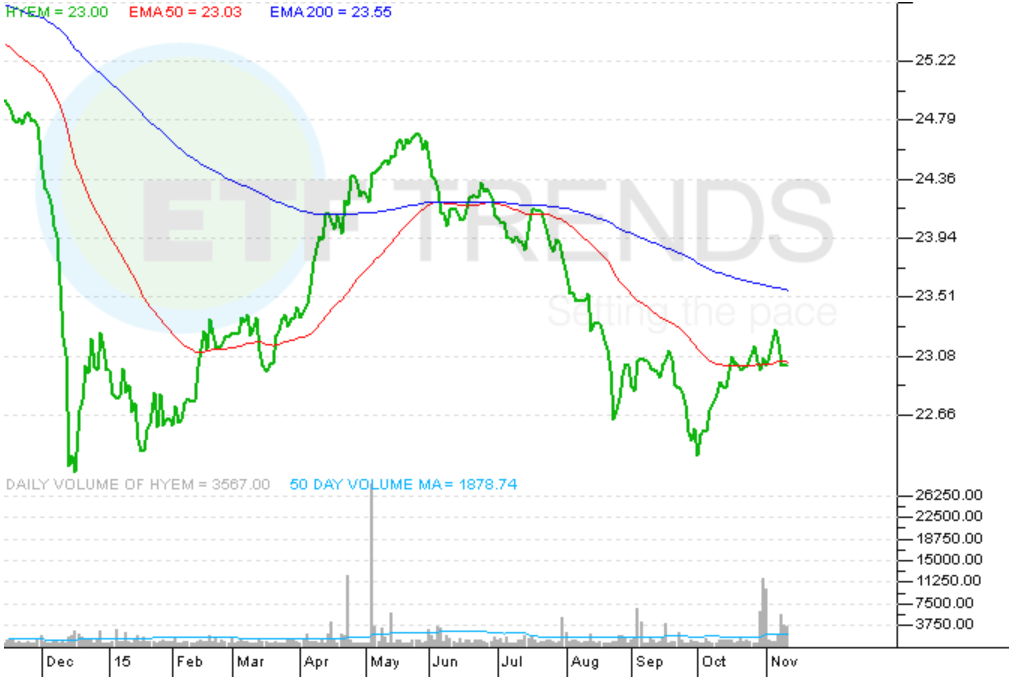
For now, emerging market debt has outperformed U.S. corporate bonds. Year-to-date, the Market Vectors EM High Yield Bond ETF (NYSEArca: HYEM) rose 6.7% and iShares Emerging Markets High Yield Bond ETF (BATS: EMHY) gained 4.6%. In contrast, the iShares iBoxx $ High Yield Corporate Bond ETF (NYSEArca: HYG) fell 3.0% and SPDR Barclays High Yield Bond ETF (NYSEArca: JNK) dropped 3.8%.
ETF investors may have also been attracted to the higher yields coming out of the emerging markets. HYEM has a 8.44% 30-day SEC yield and EMHY has a 7.62% 30-day SEC yield. On the other hand, HYG has a 6.84% 30-day SEC yield and JNK has a 7.10% 30-day SEC yield.
Looking ahead, highly leveraged emerging markets, notably growing debt from Asian economies, could experience greater default rates. Emerging market corporate debt has jumped fivefold over the past decade, totaling $23.7 trillion in early 2015, with much of the debt issued from emerging Asia where nonfiancial corporate debt to GDP ratio has increased to 125% from 100% five years ago.
The developing markets will have to payback a rising debt load as observers warn of slowing growth, especially out of China. The weaker emerging currencies will also make it harder to repay back debt for U.S. dollar-denominated debt in a strengthening USD environment. Moreover, borrowing costs are rising on expectations the Federal Reserve will soon raise rates.
“There’s clear stress in the market: Companies that have less-than-robust businesses and debt on their balance sheets are suffering and will continue to suffer,” Neil Macdonald, head of restructuring in Asia at Kirkland & Ellis LLP, told the Wall Street Journal.
Market Vectors EM High Yield Bond ETF
For more information on the fixed-income market, visit our bond ETFs category.
Max Chen contributed to this article.