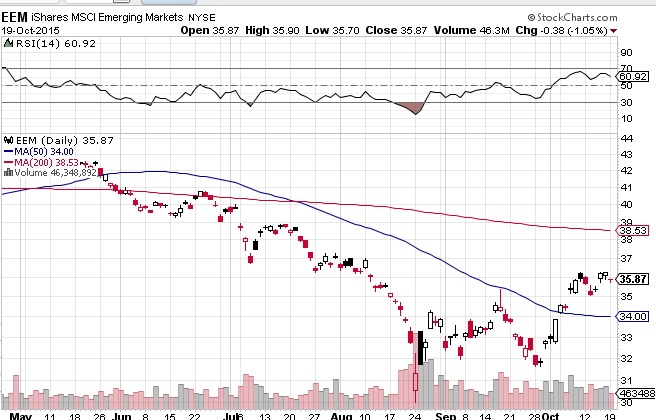
Emerging market stocks and related exchange traded funds have strengthened on the prospects that the Federal Reserve would hold off on an interest rate hike and increased stimulus from China would stabilize growth, but the asset class may have a hard time sustaining the rally.
Over the past month, the Vanguard FTSE Emerging Markets ETF (NYSEArca: VWO) and the iShares MSCI Emerging Markets ETF (NYSEArca: EEM), the two largest emerging markets exchange traded funds by assets, gained 4.7% and 4.9%, respectively. [A Popular ETF Play To Be Weary Of]
“The recovery in EM assets that accelerated after the US September payrolls disappointment is beginning to shift from being about cutting of shorts to reengagement of longs. The IIF estimates that after large outflows from EM assets in Q3, inflows have surged over the past week. EM currencies and equities have been the main beneficiary of these flows so far,” Ray Farris and Trang Thuy Le, research analysts at Credit Suisse, told Business Insider.
Specifically, the Credit Suisse analysts attribute the recent bounce in emerging markets to the delayed Fed hikes and an expectation that fiscal stimulus is stabilizing growth in China.
New York Federal Reserve Bank President William Dudley argued that it is too early to think about a rate hike due to concerns about global growth, reports Francesca Landini for Reuters.
“We estimate that the market has gone from pricing a cumulative 25bps of Fed hikes through the January 2016 meeting on September 17 to now pricing a full hike only by August of next year,” Credit Suisse analysts said.
Meanwhile, China’s economy expanded at a quicker than expected pace in the third quarter after policy makers deployed a number of was to cushion the recent slowdown, Bloomberg reports.
China is the largest country component in the emerging market ETFs, including 23.5% of China and 27.2% of VWO.
Additionally, the strengthening commodities market, notably metals prices, also contributed to a rebound in emerging market currencies.
However, the emerging markets are still vulnerable to certain risks, namely a sudden interest rate hike from the Fed if the Chinese economy and other developing economies find a stable footing.
“One is that if China’s growth does indeed recover somewhat it would increasingly remove a key reason behind the Fed’s delay at the September meeting,” Credit Suisse added. “The stronger and sooner the Chinese recovery, the more the market will have to pull forward Fed hikes and increase pricing of the terminal rate, in our view.”
Investors can also hedge against a pullback in the emerging markets through inverse ETF options. For instance, the ProShares Short MSCI Emerging Markets (NYSEArca: EUM) takes the inverse or -100% daily performance of the MSCI Emerging Markets Index, the benchmark to EEM. The ProShares UltraShort MSCI Emerging Markets (NYSEArca: EEV) follows the -2x or -200% daily performance of the Emerging Market Index. Additionally, the Direxion Daily Emerging Markets Bear 3x Shares (NYSEArca: EDZ) tracks the -3x or -300% performance of the benchmark. [Expert Bears Down On Emerging Markets]
iShares MSCI Emerging Markets ETF
For more information on the developing economies, visit our emerging markets category.
Max Chen contributed to this article.