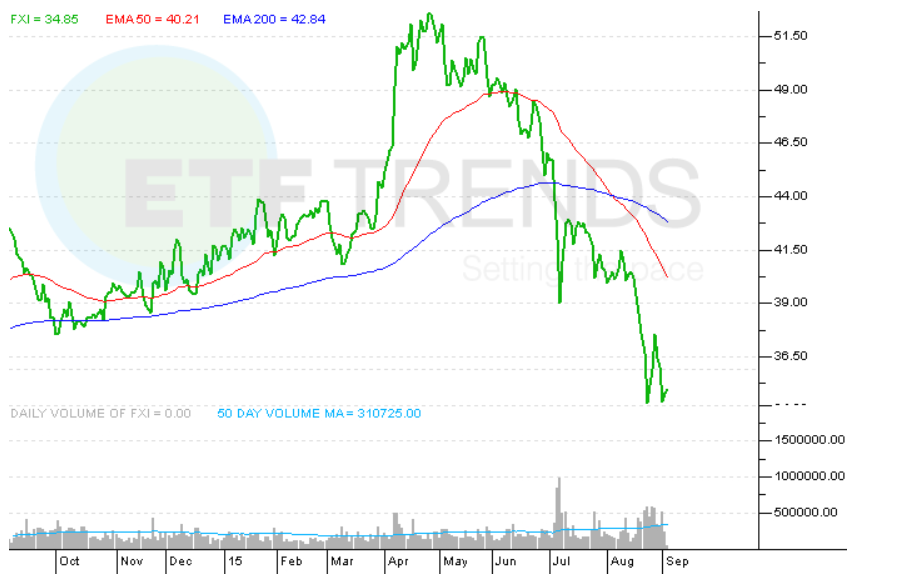
Chinese stocks, the relevant U.S.-listed exchange traded funds and the yuan currency for that matter have been primary catalysts in roiling global financial markets over the past several months, but some market observers see opportunity in the world’s second-largest economy.
Given the sheer size of the economy – China is the second largest in the world, exponential growth will be harder to maintain, so investors should expect slower and mores stable growth in the years ahead.
Looking over the long-term, investors will be able to capitalize on the country’s growing middle class. Rogers pointed out that the rising income levels would help bolster domestic consumption and fuel economic growth. [China’s Economy Is Undergoing a Huge Transformation That No One’s Talking About]
“Goldman Sachs Group Inc. is sticking with its bullish view on Chinese stocks in Hong Kong, saying valuations are inexpensive and improving economic data will spur a rebound,” reports Kana Nishizawa for Bloomberg.
“The snapback in China could be fairly meaningful,” Timothy Moe, chief Asia Pacific equity strategist at Goldman, said in an interview Wednesday. “The risk versus reward in terms of what’s priced in the market gives us a sense that if we see a stabilization in macro data, say from here to the end of the year for example, then we could see a decent recovery.”
Over 260 U.S.-listed ETFs feature some exposure to China with marquee names including the iShares China Large-Cap ETF (NYSEArca: FXI) is the largest China-related ETF that tracks Chinese companies listed on the Hong Kong stock exchange. Similarly, other China H-shares ETFs options include the SPDR S&P China ETF (NYSEArca: GXC) and the iShares MSCI China ETF (NYSEArca: MCHI).
Additionally, investors can take a look at China A-shares ETFs that track mainland Chinese stocks traded in Shanghai and Shenzhen, including the Deutsche X-trackers Harvest CSI 300 China A-Shares ETF (NYSEArca: ASHR), KraneShares Bosera MSCI China A ETF (NYSEArca: KBA) and Market Vectors ChinaAMC A-Share ETF (NYSEArca: PEK).
Investors may target some of the cheapest emerging markets and that includes Chinese stocks trading in Hong Kong, or A-shares, as FXI, GXC and MCHI all sport P/E ratios below that of the MSCI Emerging Markets Index. [Cheap EM ETFs]
A potential stumbling block for a recovery in Chinese stocks is sagging profitability at major Chinese banks.
“In the second quarter, profit at publicly listed Chinese banks grew only 1.7% from a year ago, the worst showing in a decade. The Big Four China banks saw virtually no profit growth, the 9 joint-stock banks’ profit grew only 4.4%. Only the 5 city commercial banks reported decent 14.1% profit growth. At 11% year-on-year, revenue growth was far more respectable. But much of that was boosted by strong fee income that came out of the stock market rally. Chinese banks saw 20.8% increase in net fee income and we can’t expect that to repeat in the second-half,” reports Shuli Rhen for Barron’s.
Financial services is usually the largest sector weight by a wide margin in China ETFs and that is the case with several of the funds highlighted here.
iShares China Large-Cap ETF