Amid a surge in volatility that has stung global equity markets, the Japanese yen’s status as a safe-haven currency has been restored, sending the CurrencyShares Japanese Yen Trust (NYSE: FXY) higher by 4.7% over the past month.
The yen’s spike has prompted global investors to run for the exits when it comes to Japanese equities, but inflows to some of the major Japan exchange traded funds trading in the U.S. have been steady since the start of August.
“Foreigners last week sold a net 1.85 trillion yen ($15.4 billion) of Japanese stocks and equity index futures, the biggest combined outflow since Mizuho began tracking the data more than a decade ago, said Yutaka Miura, a Tokyo-based senior technical analyst at the brokerage. Investors are fleeing amid concern about China’s economic outlook and the prospect of higher interest rates in the U.S.,” Bloomberg reports, citing Mizuho Securities Co.
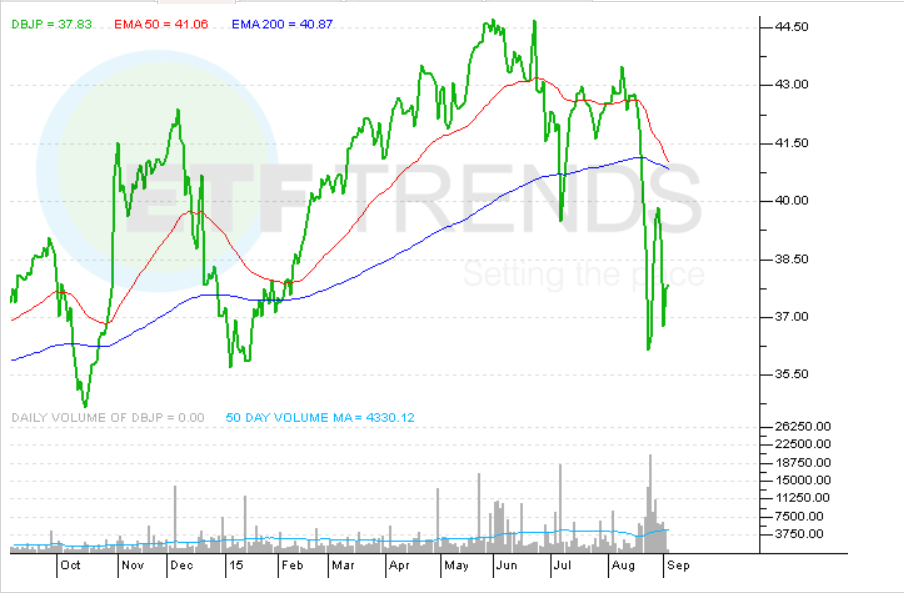
Even with those departures from Japanese stocks and the yen’s recent rise, investors continue piling into Japan ETFs, both of the currency hedge and non-hedged varieties. Since the start of August, the iShares MSCI Japan ETF (NYSEArca: EWJ) has added over $111 million in new assets while inflows to the Deutsche X-trackers MSCI Japan Hedged Equity ETF (NYSEArca: DBJP) have been over $108 million. The WisdomTree Japan Hedged Equity Fund (NYSEArca: DXJ) has added $444 million over that period.
Looking at equity valuations, Japanese stocks look cheaper than the U.S. For instance, EWJ shows a 16.0 price-to-earnings ratio and a 1.4 price-to-book, whereas the S&P 500 index is trading at a 18.7 P/E and a 2.5 P/B.
For ETF investors, currency-hedged Japan ETF options may be a better play to hedge against the negative effects of a depreciating yen while capturing potential growth from loose monetary policies. [Post-Pullback Opportunity in Japan]
As the Bank of Japan adheres to a loose monetary policy and the Federal Reserve moves toward hiking interest rates, currency risks will be an issue with overseas investments. Nevertheless, investors may utilize yen currency-hedged options to take a more pure play on the underlying Japanese markets.
Yen hedged ETFs have enjoyed strong gains after Prime Minister Abe introduced his so-called three arrows. Monetary easing and fiscal stimulus have buoyed Japanese equities and weakened the yen in the past few years.
Another option to consider is the recently launched Deutsche X-trackers Japan JPX-Nikkei 400 Equity ETF (NYSEArca: JPN) tracks the relatively new JPX-Nikkei 400 Index, which is also being used as a benchmark for Japan’s Government Pension Investment Fund, the largest pension fund in the world. [A New ETF for Japan’s Revitalized Equity Market]
Deutsche X-trackers MSCI Japan Hedged Equity ETF