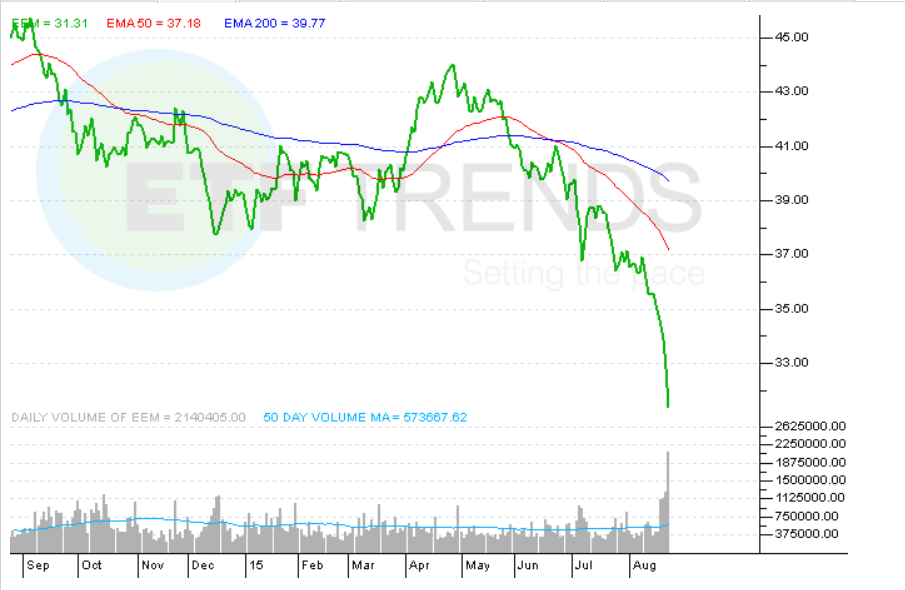
To this point in 2015, the iShares MSCI Emerging Markets ETF (NYSEArca: EEM) is the only emerging markets exchange traded fund among the 10 worst ETFs in terms of year-to-date outflows, but that data point barely scratches the surface of how much capital investors have pulled from emerging markets funds over the past year.
The $6.3 billion bled by EEM this year, as of Aug. 21, is a scant percentage of the $1 trillion investors have yanked from emerging markets stocks and funds since July 2014.
“Money has been pouring out of developing economies at a faster pace, and for longer, than during global financial crisis of 2008 and 2009, according to data from NN Investment Partners, a bank based in the Netherlands,” according to CNN Money. “About one trillion dollars has been withdrawn since July 2014, double the amount that fled during the nine months to March 2009, it said.”
Last year, EEM and the WisdomTree Emerging Markets Equity Income Fund (NYSEArca: DEM) were the emerging markets ETFs found among that year’s top 10 asset losers. Emerging markets stocks and funds face a variety of headwinds, including recessions in Brazil and Russia, tumbling commodities prices and China’s recent yuan devaluation.
China’s currency devaluation is aimed at propping up exporters in the world’s second-largest economy amid slack economic data. Beijing revealed that exports declined 8.3% in July, the largest drop in four months and worse than the expected 1% dip. Exports to the Eurozone plunged 12.3% in July and shipments to the U.S. fell 1.3%. [Violent Turn for the Yuan]
“The yuan devaluation may signal that China’s efforts to rebalance its economy toward greater growth may be proving more challenging than anticipated. According to some estimates, the trade-weighted yuan has increased by over 11% in the past year, and exports have been falling sharply — down 9.2% in July. A weaker yuan may help turn growth around by boosting China’s exports, but a roughly 2% currency devaluation is only a small step toward that goal,” said Invesco in a recent research note.
“Investors are now backpedaling fast after pouring around two trillion dollars into emerging markets between 2009 and 2014 in the search of better returns than the zero interest rates on offer in many developed economies,” according to CNN Money.
Investors should look at the emerging market equities as a more cyclical asset. Currently, after years of outperformance in the developed markets, the emerging markets are beginning to show a lower premium to more developed countries. [Look to Emerging Market ETFs in the Second Half]
iShares MSCI Emerging Markets ETF