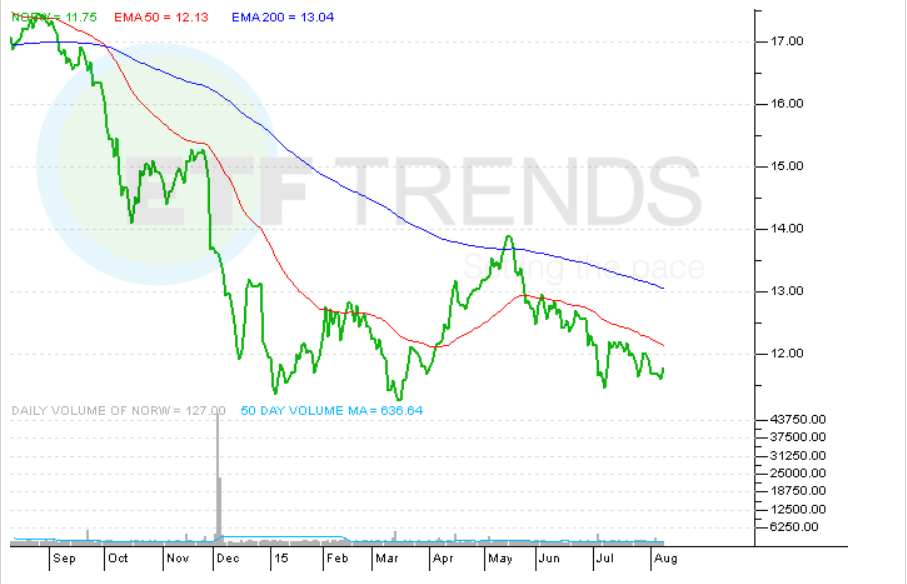
Plenty of single-country exchange traded funds are being pinched by oil’s decline, but some developed markets funds are proving far from immune as well. Norway is a prime example.
Over the past 90 days, the United States Brent Oil Fund (NYSEArca: BNO) is off 25%. That decline is having a significant impact on ETFs tracking Norway, one of the largest developed market producers of oil. During that period, the Global X MSCI Norway 30 ETF (NYSEArca: NORW) and the iShares MSCI Norway Capped ETF (BATS: ENOR) have plunged 12.4% and 13.8%, respectively.
Those ETFs; woes and those of Norwegian stocks in general boil down to Norway’s status as one of the world’s largest non-OPEC, developed market oil producers. Only two non-OPEC producers – Russia and Mexico – depend on oil for a higher percentage of government revenue than Norway does, according to Quartz.
Oil production drives about 30% of government receipts in Norway, barely less than in OPEC member Ecuador. That percentage is also far greater than oil’s contributions to government revenue in Canada and the U.S., also two of the largest developed market oil producers. [Oil Plagues Frontier Markets ETFs]
“Falling oil prices already pushed the jobless rate to 4.3 percent in May, the highest in at least 11 years, and that was before a renewed drop in Brent crude,” reports Saleha Mohsin for Bloomberg.
Oil has made Norwegian stocks the region’s worst performers in recent months. Over the past three months, the comparable Denmark ETF has posted a slight gain while the comparable Finland ETF has notched a modest loss. The iShares MSCI Sweden ETF (NYSEArca: EWD) has tumbled 5.6%, but that less than half as bad as the losses incurred by ENOR and NORW over the same period. [Country ETFs Crushed by Oil]
ENOR allocates nearly 30% of its weight to the energy sector, or more than 800 basis points more than its weight to financial services stocks, the ETF’s second-largest sector allocation. NORW, the bigger and older of the two Norway ETFs, has an energy sector weight of 32.3% at the end of the first quarter. That is roughly 60% larger than ETF’s weight to the financial services sector.
“If the government has to withdraw money from its $875 billion sovereign wealth fund, it will be a historical step. It’s either that, or heavily rein in fiscal spending at a time when the country needs it most. The state’s spending could start to outstrip income from oil, which it pours into its wealth fund for future generations,” according to Bloomberg.
Global X MSCI Norway 30 ETF