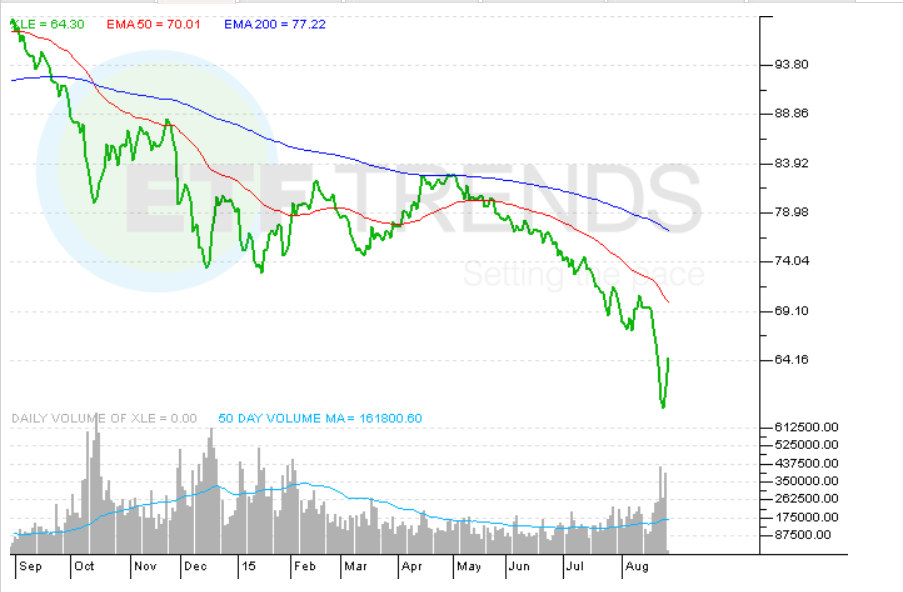
Thursday was a day to remember for oil futures and energy exchange traded funds as seven of the day’s 10 best ETFs in terms of percentage gains were energy funds. The Energy Select Sector SPDR (NYSEArca: XLE), the largest equity-based energy ETF, gained nearly 3% yesterday, a welcomed sight for one of this year’s worst-performing sector funds.
Still, investors should be careful with putting too much faith in what amounts to, at least for now, a one-day rally in the energy patch.
On Monday, CNBC reported that among the 20 most widely held stocks by institutional investors in the second quarter, just two were energy stocks, Royal Dutch Shell (NYSE: RDS-A) and Chevron (NYSE: CVX). That is down from three in the first quarter when Exxon Mobil (NYSE: XOM) was also on the list.
“The percentage of institutional funds that owned Chevron dropped 40 basis points during the quarter, down to 12.53 percent from 12.93 percent. But the recent shift away from the energy stocks begs the question of whether they were oversold,” notes CNBC. [Pros Ditch Energy Stocks]
“With over a quarter of XLE in significant down trends, you can pretty much put a nail in the coffin for performance for a while,” according to a post on Seeking Alpha. http://seekingalpha.com/article/3471696-dont-expect-a-turnaround-in-your-favorite-energy-etf-anytime-soon
There are some green shoots emerging on the industry consolidation front. The Market Vectors Oil Service ETF (NYSEArca: OIH) has been climbing this week thanks in part to news that Schlumberger (NYSE: SLB) said it will acquire rival Cameron International (NYSE: CAM) for $12.7 billion.
Additionally, some Wall Street analysts see Cameron rivals such as FMC Technologies, Inc. (NYSE: FTI), Aker Solutions, Forum Energy Technologies, Inc. (NYSE: FET) and Dril-Quip, Inc. (NYSE: DRQ) as potential takeover targets. National Oilwell Varco (NYSE: NOV) and Weatherford International plc (NYSE: WFT) could also be targets.
Investors should keep in mind that the oil services sector is heavily reliant on capital spending cycles in the energy industry. The recent sharp cuts in capital expenditure budgets in 2015 contributed to the pullback in oil services – U.S. companies are expected to spend about 20% less than the average over 2014, with some cutting expenditures by around 50%. [Problems for Energy ETFs]
Energy Select Sector SPDR