This year is turning out to be another tricky one for emerging markets investors, but breaking away from the traditional mold of emerging markets exchange traded funds could prove beneficial over the long term.
That break should include an emphasis on knowledge-intensive, innovating companies, a concept the new Gavekal Knowledge Leaders Emerging Markets (NYSEArca: KLEM) delivers on. The knowledge effect’s roots can be traced back to the early 1970s when the first semiconductor became commercially available and a 1974 mandate by the Financial Accounting Standards Board (FASB), which ruled companies must expense knowledge investments in the period those expenses were incurred. As Gavekal notes, that deprives investors of relevant information on knowledge-driven expenditures.
Denver-based Gavekal also introduced the Gavekal Knowledge Leaders Developed World ETF (NYSEArca: KLDW) today, making the firm the first to offer strategic beta ETFs that emphasize the investment merits of the knowledge effect. KLEM tracks the Gavekal Knowledge Leaders Emerging Markets Index (KNLGE).
“The Knowledge Effect is the tendency of highly innovative companies to experience excess returns. The investment process aims to capture this market inefficiency using a proprietary methodology which capitalizes corporate knowledge investments, measures firm performance on a knowledge-adjusted basis, and selects investments in Knowledge Leader companies on the basis of knowledge intensity,” according to Gavekal.
At a time when Latin American equities continue struggling, KLEM is an attractive bet at the country level because the new ETF’s underlying index allocates nearly three-quarters of its weight to Asian companies. KLEM, which seizes on growing momentum for smart or strategic beta ETFs, can serve as a replacement for the traditional emerging markets ETFs advisors and investors have previously viewed as “core holdings.” [This ETF Excludes State-Run Companies]
“Strategic beta is a disruptive technology for investors. It’s a new type of product that is attempting to capture active share in a rules-based, transparent way that is cheaper, more tax efficient and easier to use. The promise of strategic beta is active share for everyone,” said Steven Vannelli, chief investment officer at Gavekal Capital, in an email exchange with ETF Trends.
Vannelli manages $600 million in knowledge leaders strategies, including ETFs, separately managed accounts and a mutual fund.
KLEM is attractive for other reasons, including its robust exposure to the emerging markets consumer spending theme. The new ETF’s underlying index allocates nearly 45% of its combined weight to the consumer discretionary and staples sector. The index’s second-largest sector weight is 21.1% to technology, indicating KLEM delivers on the promise of being a legitimate alternative to old guard emerging markets ETFs by steering away from excessive energy and financial services weights. Those sectors combine for just 1% of KLEM’s index. [Top EM Consumer ETFs]
KLEM charges 0.95% per year.
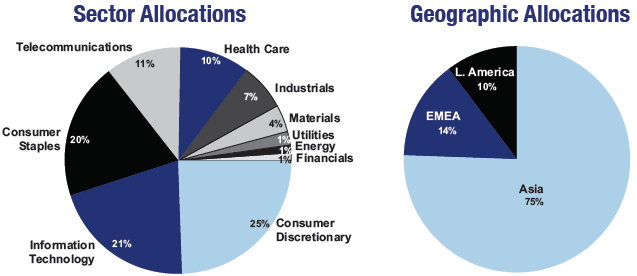
Chart Courtesy: Gavekal Capital