After the recent sell-off in Chinese equities, investors who are now interested in entering the market at a lower price level should consider China H-Shares-related exchange traded funds as a cheap play.
Looking at valuations, Shanghai Composite and the small-cap Shenzhen Composite are still relatively expensive, even after the correction, trading at an average price-to-earnings ratio of about 20 and 50 times, respectively, reports Jenny Cosgrave for CNBC. [Contrarians See Opportunity After China Stocks, ETFs Plunge]
The Deutsche X-trackers Harvest CSI 300 China A-Shares ETF (NYSEArca: ASHR), which tracks large- and mega-caps on the Shanghai and Shenzhen exchanges, is trading at a 16.4 P/E. The Deutsche X-trackers Harvest CSI 500 China A-Shares Small Cap Fund (NYSEArca: ASHS), which covers a group of large- and mid-cap Chinese A-Shares, shows a 39.4 P/E.
Over the past three months, ASHR dropped 18.3% and ASHS fell 11.6%. However, ASHR still rose 7.0% and ASHS jumped 38.6% year-to-date. [After Volatility, Opportunity in A-Shares ETFs]
On the other hand, Goldman Sachs chief global equity strategist Peter Oppenheimer pointed out that there are more attractive valuations in blue-chip, large-cap Hong Kong-listed Chinese companies.
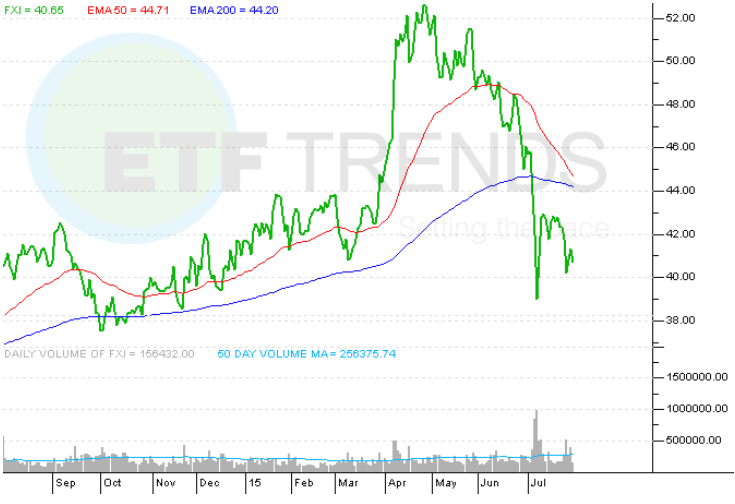
For instance, the iShares China Large-Cap ETF (NYSEArca: FXI), the largest China-related ETF that tracks Chinese companies listed on the Hong Kong stock exchange, has a 11.2 P/E. Similarly, other China H-shares ETFs options include the SPDR S&P China ETF (NYSEArca: GXC), which has a 11.7 P/E, and the iShares MSCI China ETF (NYSEArca: MCHI), which has a 11.8% P/E.
Over the past three months, FXI declined 20.4%, GXC dropped 17.6% and MCHI decreased 19.2%.
“You have to take quite a nuanced view on China, I think it is important to emphasize there are different parts of China that are trading at very different multiples,” Oppenheimer said on CNBC. “The smaller cap stocks at the A-share market are still trading at high 20s and that is very expensive by historic standards, whereas if you look at the blue-chip companies and those listed on Hong Kong, they tend to trade at multiples of 9.5/10 times and are relatively cheap by historic standards.”
iShares China Large-Cap ETF
For more information on China, visit our China category.
Max Chen contributed to this article.