U.S. equities and stock-related exchange traded funds have bounced back, but investors should not be concerned about a bubbling market as valuations have fallen on an improving earnings outlook.
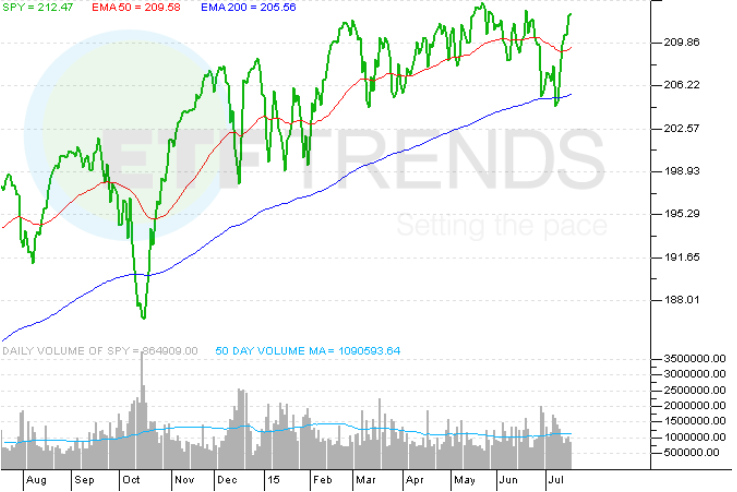
Over the past week, the SPDR S&P 500 ETF (NYSEArca: SPY), iShares Core S&P 500 ETF (NYSEArca: IVV) and Vanguard 500 Index (NYSEArca: VOO) have gained 2.4%. Year-to-date, the S&P 500 ETFs are up about 4.4%. [U.S. Stocks, ETFs Could Rebound on Improved Earnings]
The S&P 500 Index was trading around 2,132 Monday, a little shy of its May 21 all-time high.
However, according to FactSet, the S&P 500’s forward price-to-earnings ratio, a widely observed measure of valuation, was at 16.8 as of Friday’s close, reports Alex Rosenberg for CNBC. In contrast, the recent peak for forward P/E was 17.3 at the start of March.
Consequently, the S&P 500 is currently reaching toward new highs at lower valuations than in May, the last time a record was breached. Nevertheless, investors should still be aware that valuations are slightly elevated on a historical basis.
The recent moves in the equities market suggest that stock price gains are relatively stable. Supporting the current rally, many investors have a positive outlook on the current earnings season – of the first 61 S&P 500 companies to report results, 72% beat profit estimates.
Looking ahead, investors would anticipate equities to lead ahead of earnings as the economic outlook slowly improves and valuations would eventually drop as the bullish case pans out.
“Sure, we’re seven years into a bull market, but we’re also seven years into an economic expansion,” Albert Brenner, head of the asset allocation strategy team at People’s United Wealth Management, told CNBC. “You might well marry the question, ‘How comfortable am I with holding equities now?’ with the question, ‘How comfortable am I with the U.S. expansion in the U.S. continuing.'”
Meanwhile, the CBOE Volatility Index reveals that investors are growing more complacent with the current market rally. The VIX is currently shows a 12 reading, falling almost 30% over the past week to its lowest level since December 2014.
“We seem to have this aura of calmness,” Boris Schlossberg of BK Asset Management said on CNBC. “It’s very likely stock gains are going to continue, and the VIX is going to continue to go down.”
SPDR S&P 500 ETF
For more information on the market, visit our current affairs category.
Max Chen contributed to this article.
Full disclosure: Tom Lydon’s clients own shares of SPY and IVV.