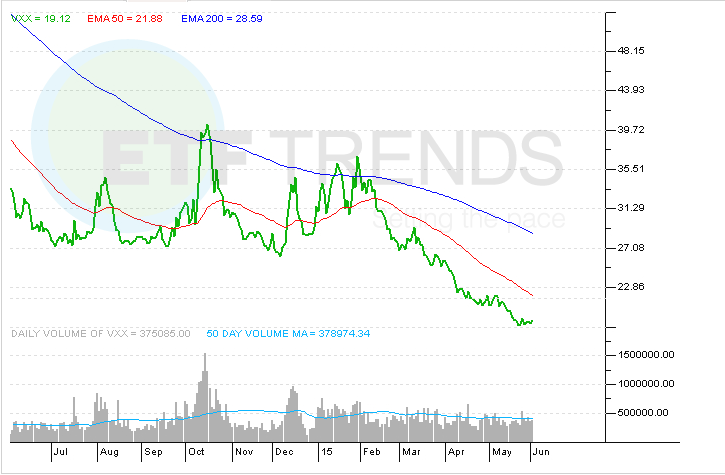
“Volatile” probably is not the most accurate description of U.S. equity markets to this point in 2015, but plenty of traders are betting that is set to change as the Federal Reserve inches closer to raising interest rates. Those traders are using various volatility exchange traded products to express their views.
“Year-to-date, roughly $1.9 billion has flowed into ETFs wagering on a rise in volatility, while some $1.1 billion has flowed out of ETFs betting on a drop in volatility, based on a Reuters analysis of FactSet data,” reports Ashley Lau for Reuters.
As Reuters notes, the iPath S&P 500 VIX Short Term Futures ETN (NYSEArca: VXX) has seen year-to-date inflows of $766 million. Traders have added nearly $108 million to one of VXX’s rivals, the ProShares VIX Short-Term Futures ETF (NYSEArca: VIXY). Both products are down more than 40% this year.
Skeptical investors have been slowly adding onto their VIX hedges in anticipation of an eventual violent turn, despite the low volatility experienced this year. That has helped buoy some new volatility products as well. For example, the AccuShares Spot CBOE VIX Up Shares (NYSEArca: VXUP) has needed less than two weeks of trading to capture $11.4 million in assets, according to AccuShares data.
VXUP tries to reflect the spot price return of the CBOE Volatility Index, or VIX. VXUP and its bearish equivalent, the AccuShares Spot CBOE VIX Down Shares (NasdaqGM: VXDN), were designed as better alternatives to legacy volatility ETFs and ETNs because the AccuShares products look to damp the erosive effects of contango investors deal with products like VXX. Since ETFs have to roll over contracts, or sell those close to maturity, and buy a later-dated contract, these futures-based VIX ETFs would essentially sell low and buy high, losing money on each roll during a contangoed market. [New VIX ETFs Coming]
VXDN came into Wednesday with nearly $8.7 million in assets under management. That is a decent start for the bearish volatility product, particularly when considering market participants have pulled cash from inverse volatility funds this year. The VelocityShares Daily Inverse VIX Short-Term ETN (NYSEArca: XIV) and ProShares Short VIX Short-Term Futures ETF (NYSEArca: SVXY) have lost $680 million and $454.2 million, respectively, this year despite each rising 46%. [Market Complacency on the Rise]
During normal conditions, a falling VIX would reflect increased confidence and strengthening in the equities market, and vice versa. However, despite the swings, the relatively flat market this year has pressured the VIX.
iPath S&P 500 VIX Short-Term Futures ETN