Ten-year Treasury yields are soaring again Monday, trading higher by 4.3% at this writing. That brings the three-month gain for yields on benchmark U.S. government debt to a staggering 23.5%, more than enough to inflict pain on an array of rate-sensitive asset classes and sectors.
Of course, that includes real estate investment trusts (REITs) and the corresponding exchange traded funds. Major REIT ETFs have been decked by rising Treasury. For example, the average three-month loss for the Vanguard REIT ETF (NYSEArca: VNQ) and the iShares Dow Jones US Real Estate Index Fund (NYSEArca: IYR) is over 9%. Options market data indicate some traders are betting the worst is over for IYR, at least in the near-term.
“We saw more than 46,000 contracts (IYR calls) trade on Friday which was more than double the open interest coming into the day,” according to ETF liquidity provider Street One Financial.
REITs are securities that trade like a stock and invest in real estate directly through property ownership or mortgages. Consequently, revenue are mainly generated through rents or interest on mortgage loans. To qualify for special tax considerations, the asset also distributes the majority of income, about 90% of taxable profits, to investors as dividends. [Sticking With a Popular REIT ETF]
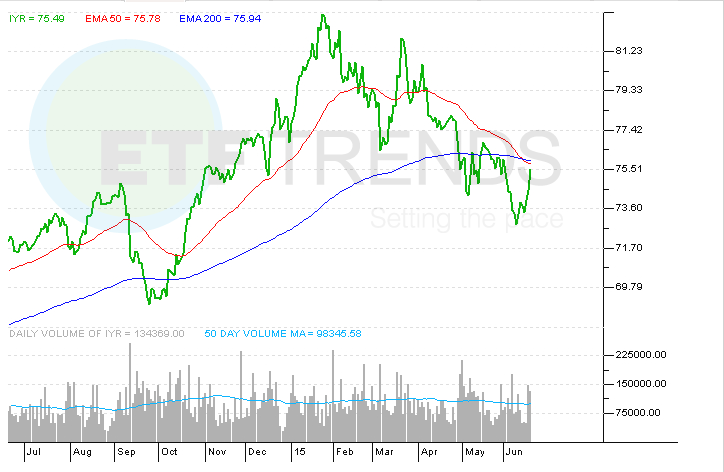
“IYR has struggled a bit lately, challenged on the upside by both its 200 day and 50 day MA’s, both of which are right around the $76 level. Trading volume has been above normal in recent sessions as well in the product, but fund flows rather flat in the trailing one month with a net of about $13 million leaving the fund during this time period, which is a rather inconsequential amount,” said Street One Financial Vice President Paul Weisbruch in a note out Monday.
While IYR’s outflows have recently been modest, second-quarter REIT ETF departures have been anything but slight. Investors have yanked $1.9 billion from VNQ, the largest REIT ETF, this quarter. Only three ETFs have lost more assets over that period. Nearly $1.6 billion has been pulled from IYR, a total surpassed by just five other ETFs.
There are other catalysts that can help REIT ETFs navigate a rising rate environment, including still high levels of apartment renting. Apartment demand has not let up, despite calls that improving economic conditions would push more into buying homes. Supporting the increased rental demand, millennials are finding jobs and moving out to cities.
Moreover, without meaningful wage increases, renters may be stuck with rental apartments as they are not able to save enough for that first home down payment. [Renters Are Stuck, Continue to Support Residential REITs ETFs]
iShares Dow Jones US Real Estate Index Fund