Call it a potential catalyst or problem. Either way, hedge funds are loading up on bearish bets against Japanese stocks, but investors in the corresponding exchange traded funds don’t seem to mind.
During Thursday’s Asian session, the short selling ratio on Japan’s benchmark Nikkei rose to 38.3%, the highest level since Japan began keeping such records in 2008, according to a tweet by Rareview Macro founder Neil Azous.
Though it has been the wrong trade on Japanese stocks, short selling in Asia’s second-largest economy has been in style this year with levels rarely dipping much below 28% since the start of 2015, reports Leo Lewis for the Financial Times.
Various media outlets attribute the sharp increase in bearish bets against Japanese stocks to foreign investors, including some U.S. hedge funds. However, ETF investors are taking a markedly different tact.
Since the start of this month, investors have added nearly $635 million to the iShares MSCI Japan ETF (NYSEArca: EWJ), a total surpassed by just nine other ETFs. Bearish wagers against Japanese stocks come as the yen remains weak, though the CurrencyShares Japanese Yen Trust (NYSEArca: FXY) has perked up a bit this month, rising 0.4%. However, FXY is lower by 1.2% over the past 30 days and is off 2.5% this year. [Investors Still Like the Japan ETF Trade]
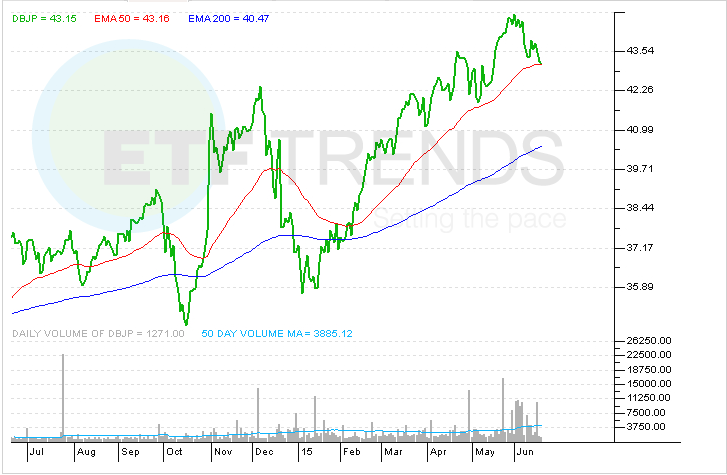
ETF investors are apparently questioning the veracity of the yen’s recent, albeit modest, rise. Since the start of June, the WisdomTree Japan Hedged Equity Fund (NYSEArca: DXJ) and the Deutsche X-trackers MSCI Japan Hedged Equity ETF (NYSEArca: DBJP) have pulled in $407.9 million and $141 million in new assets, respectively. Those June inflows bring DXJ’s year-to-date inflows to $4.2 billion, a total surpassed by just five other ETFs. [Pros Missing out on Japan ETF Strength]
DBJP has impressed as well, adding over $633 million in new assets, or nearly half the $1.3 billion in assets currently held by the ETF.
Short sellers have another issue to contend with when it comes to Japanese stocks: Increased buyback announcements. For the 12 months ended April 30, the buyback yield on five of eight WisdomTree Japan dividend and sector indexes climbed with sharp gains seen in the technology and media space along with the capital goods sector, according to issuer data.
Deutsche X-trackers MSCI Japan Hedged Equity ETF