Corporate America is throwing billions into repurchasing their own shares, bolstering company stocks and buyback-related exchange traded funds. However, the party will be short-lived.
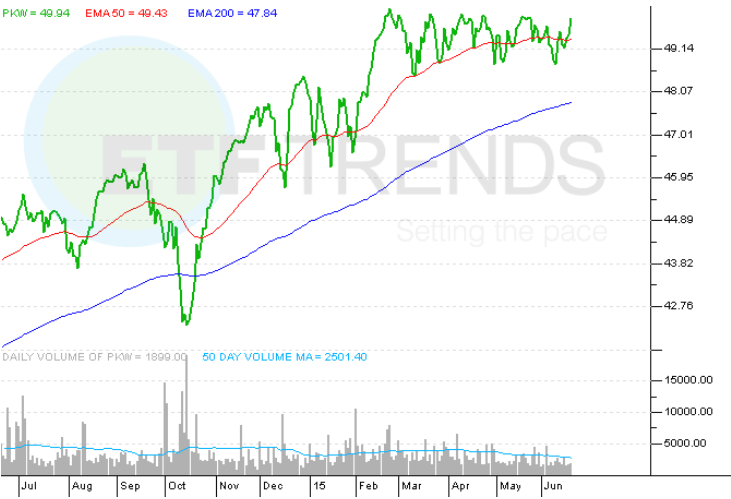
The PowerShares Buyback Achievers Portfolio (NYSEArca: PKW), which includes U.S. companies that have effected a net reduction in shares outstanding by 5% or more over the trailing 12 month period, gained 3.5% year-to-date. [Buyback ETFs Notch Another Solid Year]
Additionally, the TrimTabs Float Shrink ETF (NYSEArca: TTFS) and the Cambria Shareholder Yield ETF (NYSEArca: SYLD) both include companies that return capital to shareholders through stock repurchases. Year-to-date, TTFS increased 5.6% and SYLD rose 3.8%. [A Selective Approach to Buyback ETFs]
Howard Silverblatt, senior index analyst at S&P Dow Jones Indices, calculated that companies in the S&P 500 have bought back $148 billion of their own shares in the first quarter this year, compared to $132.6 billion in the first quarter of 2014, reports John Waggoner for the Wall Street Journal. [Buyback ETFs to Capture Record Company Stock Repurchases]
Stock buybacks helped diminish the number of shares outstanding, which has made the remaining shares that much more valuable. However, a company stock can still dip and repurchased shares can be distributed through employee options as part of their compensation.
When a company engages in repurchasing plans, it is giving up potential growth. Management could have used the money for more practical applications, such as research and development or new products.
“We think in some cases that buybacks are a tool used by managers and boards that don’t know what else to do with the cash,” Ben Silverman, vice president of research at InsiderScore, said in the article. “They’re either not creative or not growth-oriented. There’s always something to invest in, no matter what kind of company you are.”
Moreover, according to Goldman Sachs Group, Corporate America is not the best investor of its own company stocks. Buybacks peaked in 2007 with 34% of cash spent but dipped to a low of 13% in 2009 – U.S. companies essentially bought the most at the market peak and the least amount during the bear-market low.
The buybacks, though, did help support gains but only in the short-term as buyback momentum has ended badly before. The last top in buybacks was in the third quarter of 2007, which ended in a bear market. During 2007, PKW underperformed the S&P 500, partly due to the excessive buybacks that boosted earnings without a mind toward growth.
Alternatively, investors can take a look at the recently launched Elkhorn S&P 500 Capital Expenditures Portfolio (NasdaqGM: CAPX), which takes the top 100 S&P 500 companies based on efficient capital expenditure, to track U.S. firms that have reinvested their money toward meaningful growth and innovation. [An ETF That Larry Fink Would Love]
PowerShares Buyback Achievers Portfolio
For more information on stock buybacks, visit our buyback category.
Max Chen contributed to this article.
Full disclosure: Tom Lydon’s clients own shares of TTFS.