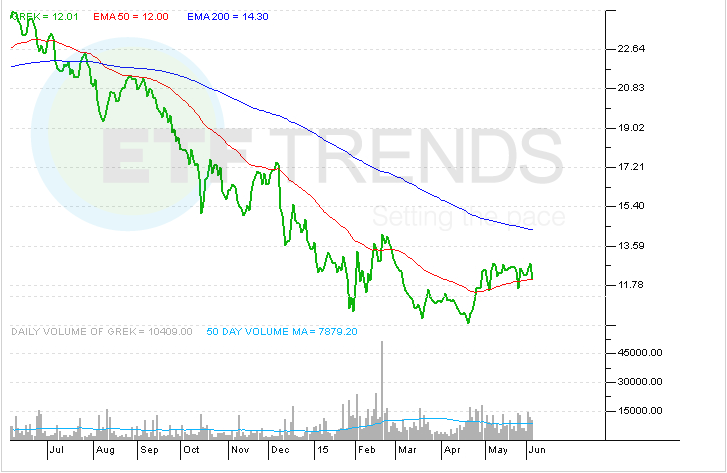
Just a week after increased bullish options activity was spotted in the Global X FTSE Greece 20 ETF (NYSEArca: GREK), data suggest short sellers are piling into the lone Greece exchange traded fund.
Amid renewed concerns that Greece’s grasp on Eurozone membership is tenuous at best, short interest in GREK has climbed to 5% of shares outstanding, reports Sudip Kar-Gupta for Reuters.
Last week, it was reported that open interest in GREK calls, the options contracts used to make bullish bets, was four times that of puts, or bearish options. With news of rising short interest in GREK, one way of looking at that options data is that professional traders that are short GREK are long calls on the ETF as a protective hedge. [Looking for Upside in the Greece ETF]
Greece is still struggling with a slowdown, record unemployment and shaky finances, Greece’s economy is showing signs of growth, with the gross domestic product expected to expand 0.5% this year, reports Jenny Cosgrave for CNBC. As a result of the weaker euro currency, a booming tourism industry and stronger exports have helped keep the country afloat. [Greece ETF Tries to Elude Debt Fears]
GREK has tumbled 13.5% this year, good for the worst performance among the single-country ETFs tracking the PIIGS economies. That performance casts a pall over the $221.4 million of inflows added by GREK this year, more than the comparable Ireland, Italy and Portugal ETFs combined.
Those inflows, which amount to just over two-thirds of GREK’s current assets under management tally of $318.4 million, could be partially attributable to the fund’s increased short interest. As short sellers borrow more shares of an ETF, new shares outstanding are created, giving the impression that the ETF is growing. When those traders cover, the ETF’s shares outstanding count falls.
Predictably, short bets on GREK “have been volatile, with traders moving quickly to shut down negative bets on positive news flow. The short interest level on the Greek ETF slumped to around zero percent in April, but it has since increased back to 5 percent as anxieties over Greece returned,” according to Reuters.
GREK has a standard deviation of 48.2%, according to Global X data. That is nearly quadruple the three-year standard deviation on the MSCI Emerging Markets Index, a relevant comparison because the major index providers classify Greece as a developing market.
Global X FTSE Greece 20 ETF