With the yen falling and Abenomics taking hold, Japanese stocks are among this year’s best developed market performers. Japanese stocks have been stellar performers for several years now as highlighted by a two-year gain of almost 36% for the Deutsche X-trackers MSCI Japan Hedged Equity ETF (NYSEArca: DBJP).
However, the Japanese equity market is experiencing a revitalization of sorts, one that can be tapped with a new exchange traded fund that offers investors to a recently launched index that takes a different approach to stocks in Asia’s second-largest economy. The Deutsche X-trackers Japan JPX-Nikkei 400 Equity ETF (NYSEArca: JPN) debuted today and benchmarks to the JPX-Nikkei 400 Index.
That index was launched in January 2014 as means of revitalizing the Japanese equity market. The JPX-Nikkei 400 Index employs a rigorous screening process based on return on equity, cumulative operating profit and market capitalization to select high-quality, capital-efficient Japanese companies,” according to a statement issued by Deutsche Asset & Wealth Management (Deutsche AWM).
The Deutsche X-trackers Japan JPX-Nikkei 400 Equity ETF looks like a well-timed launch, something that cannot be said of all new ETFs. Japanese companies are flush cash, even more cash than their U.S. counterparts, but keeping all that cash on does not boost return on equity.
As Arne Noack, Director, Development for Exchange Traded Products at Deutsche AWM, Passive, noted in an interview with ETF Trends, Japanese stocks have had historically low returns on equity compared to U.S. equivalents and corporate governance standards have been highlighted as an area requiring potential improvements compared to other developed markets.
“The JPX-Nikkei 400 Index is an initiative that fits well in a broader context,” said Noack. “The index includes companies with high capital efficiency and return on equity. Those are things that encourage positive perceptions about Japan among international investors and could increase foreign investment.” [Investors Still Like the Japan ETF Trade]
The JPX-Nikkei 400 Index currently sports a dividend yield of 1.62%, above that of the Topix and Nikkei 225, the other major Japanese benchmarks, though its sector weights are comparable. For example, at the end of May, the JPX-Nikkei 400 Index had weights to industrial and financial services stocks that were only slightly below the Topix’s weight to those sectors. The JPX-Nikkei 400 Index is overweight consumer staples and healthcare relative to the Topix.
Importantly, the JPX-Nikkei 400 Index is gaining traction among international institutional. While Deutsche AWM is the first issuer to launch a product tracking the benchmark in the U.S., the index has taken off among local Japanese investors and in Europe as various exchange traded products linked to have amassed close to $5 billion in assets as of the end of April 2015, according to Noack. [ETFs to Capture a Stronger Japanese Economy]
JPN charges just 0.4% per year, making the new ETF eight basis points less expensive than the two largest U.S.-listed Japan ETFs. While some new ETFs often struggle with liquidity and volume issues, JPN may not be afflicted with the same problems. There is already vibrant trade in exchange traded futures linked to the JPX-Nikkei 400 Index, which could serve to bolster the new ETF’s liquidity.
With assets totaling $18.5 billion as of June 16, 2015, an increase of approximately 430% since year-end 2014, Deutsche X-trackers continues to be among the fastest growing ETF franchises in the US, according to the statement. Deutsche AWM is the fifth-largest ETF issuer in the world. [More to Come for Currency Hedged ETFs]
JPX-Nikkei 400 Index
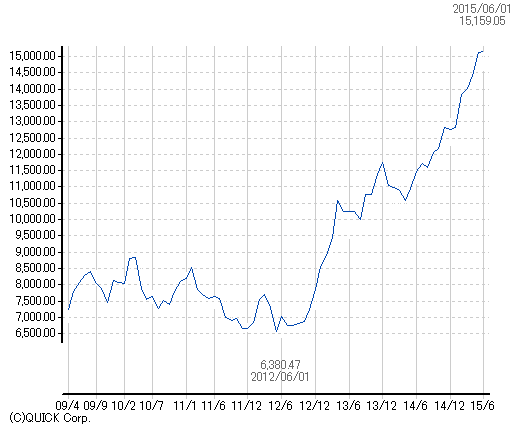
Chart Courtesy: Japan Exchange Group