With 10-year Treasury yields up more than 12% over the past month, plenty of income-generating are being pressured. The list includes, but is not limited to, longer-dated bonds and real estate investment trusts.
Looking at the lethargic one-month performances Consumer Staples Select Sector SPDR (NYSEArca: XLP), the largest consumer staples ETF, and the Utilities Select Sector SPDR (NYSEArca: XLU), which are up an average of 0.25% over the past month, it is clear investors are worried about how rising rates will affect those sectors, too. http://www.etftrends.com/2015/05/bond-proxy-etfs-show-some-investors-believe-rates-will-rise/
Predictably, preferred stock ETFs have not been immune to the recent yield jump. The iShares U.S. Preferred Stock ETF (NYSEArca: PFF) and PowerShares Preferred Portfolio (NYSEArca: PGX) are off an average of 0.55% over the past month, a performance that is certainly better than those offered by longer-dated bond funds, but also one that is far from awe-inspiring.
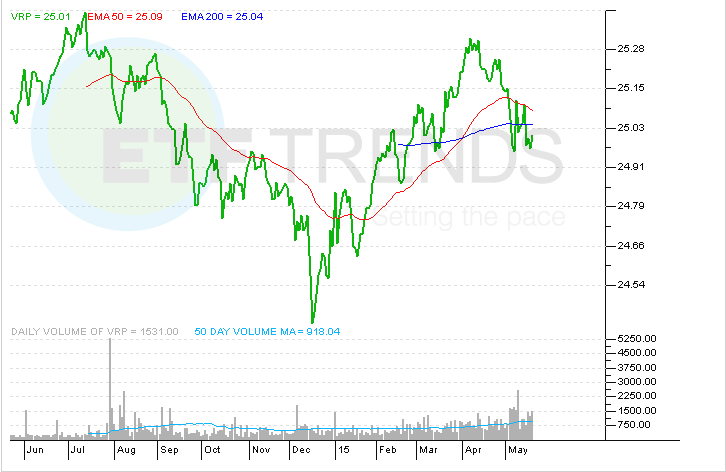
Depending on one’s point of view, the PowerShares Variable Rate Preferred Portfolio Fund (NYSEArca: VRP) has been better or less bad than rival preferred stock ETFs with a modest one-month decline of just over a third of a percent. [Fast Start for a new Preferred ETF]
“Variable-rate preferreds, on the other hand, tend to trade more like bonds with shorter durations. However, this lower risk profile is going to be welcome for many conservative investors. This way, we can earn a relatively high yield and still be protected from a ‘cleansing’ crash that Bank of America Merrill Lynch warned about. By investing in variable-rate preferreds, you can be a trailblazer rather than a herd follower,” according to Wall Street Daily.
With the interest rate outlook appearing far less sanguine as the Fed readies to boost borrowing costs, perhaps as soon as the fourth quarter, advisors and investors should take the opportunity to assess the place preferred ETFs in portfolios.
Preferred stocks are a type of hybrid security that show bond- and equity-esque characteristics. The shares are issued by financial institutions, utilities and telecom companies, among others. Within the securities hierarchy, preferreds are senior to common stocks but junior to corporate bonds. Preferred stocks issue dividends on a regular basis, but investors are unlikely to enjoy capital appreciation on par with common shares. [Rate Risk With Preferred ETFs]
VRP’s effective duration is 3.92 years, nearly a full year less than the equivalent duration on PGX, but VRP does not require a significant sacrifice in yield in exchange for that lower duration. The variable preferred ETF has a 30-day SEC yield of 4.84%, according to PowerShares data.
And for those that are into superficial statistics, there is this: PRF celebrated its first anniversary on May and is now home to $206.7 million in assets, making it one of the most successful ETFs to come to market last year.
PowerShares Variable Rate Preferred Portfolio