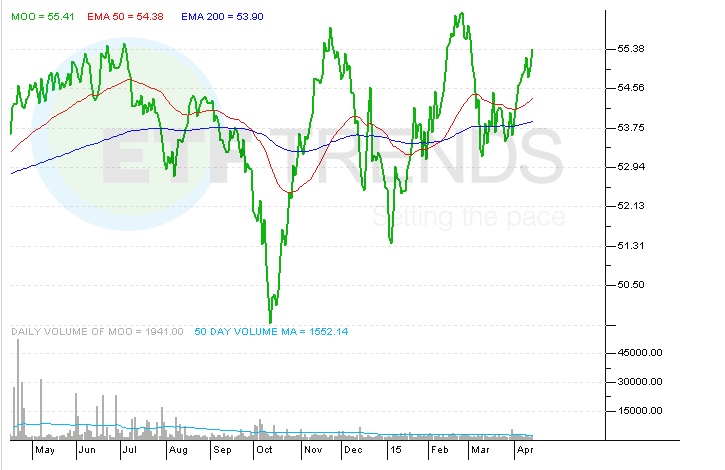
There was a time when the Market Vectors Agribusiness ETF (NYSEArca: MOO) was the largest Market Vectors exchange traded fund, but after several years of lagging the S&P 500, MOO bled $3.1 billion in assets last year.
That total was exceeded by just nine other ETFs. Since the bull market started in March 2009, MOO has only outperformed the S&P 500 twice on an annual basis. Those instances occurred in 2009 and 2010, but in a case of laggard-turned-leader, MOO is, albeit quietly, surging this year. The ETF is up 6.2%, five times the gains offered by the S&P 500 and 170 basis points ahead of the Materials Select Sector SPDR (NYSEArca: XLB). [A Bounce Back ETF]
MOO gained 1% Thursday to bring the ETF within pennies of its 52-week high. The fund needs to gain a mere 73 cents to set a new 28-month high and there are catalysts in place to just do that, namely industry consolidation.
MOO’s two largest holdings – Syngenta (NYSE: SYT) and Monsanto (NYSE: MON) – are reportedly in talks regarding a deal that could see Monsanto shell out up to $40 billion.
“German chemicals company BASF and U.S. petrochemicals group Dow Chemical could be among possible bidders for all or parts of Syngenta,” Reuters reported, citing an unidentified source. Reuters also notes Monsanto may need a partner to finalize a deal with Switzerland-based Syngenta.
Syngenta and Monsanto combined for over 16% of MOO’s weight as of May 16, according to Market Vectors data.
MOO’s favorable response to rumors of a Monsanto/Syngenta marriage is obviously important, but even more so when remembering that ETF barely budged last year when media outlets reported Norway’s Yara International (OTC: YARIY) and CF Industries (NYSE: CF) were in merger talks. Those stocks currently combine for 6% of MOO’s weight.
With natural gas prices still low, MOO is arguably home to a few other potential takeover targets. North American-based makers of nitrogen fertilizer, several of which are found among MOO’s 56-stock roster, make for attractive acquisition targets because of proximity to natural gas, a key ingredient in the production of nitrogen-based crop nutrients. [Rumor Doesn’t Boost Agribusiness ETF]
Additionally, materials stocks and other cyclical sectors are delivering upside to investors as markets anticipate higher U.S. interest rates. The materials sector is consider a late cycle, cyclical sector and those groups historically thrive in rising rate environments.
Market Vectors Agribusiness ETF