Prime Minister David Cameron swept to victory in Thursday’s U.K. election, surprising onlookers and pundits as his conservative party won 323 seats in parliament.
A stunning collapse by Labour in Scotland and the Torries strengthening their position in Wales were among the catalysts lifting Cameron and the Torries.
“Nearly every Liberal Democrat member of the government lost their seat, including Vince Cable, the Business Secretary, Ed Davey, the Energy Secretary, Danny Alexander, the Chief Secretary to the Treasury, and Jo Swinson, a business minister,” according to The Telegraph.
News of Cameron’s resounding victory has the pound and U.K. equities soaring Friday. The CurrencyShares British Pound Sterling Trust (NYSEArca: FXB) is higher by almost 1.2% and flirting with the $151.50 area, a level FXB has not closed above in nearly three months. [Sterling Hedged ETFs Could Rise]
However, the big story among U.S.-listed U.K. exchange traded funds may be coming courtesy of the newest member of that group. The Recon Capital FTSE 100 ETF (NasdaqGS: UK), which debuted last week, is up 3.4% Friday and trading at its highest levels since coming to market.
UK is the first U.S.-listed ETF to track the U.K.’s benchmark FTSE 100 index. The FTSE 100 allocates nearly 12% of its weight to energy names with banks at almost 10.5% being the only other sector to command a double-digit weight, according to Recon Capital data. Personal and home goods along with industrial goods and services each have weights north of 9% in the index.
All of the FTSE 100’s, and in turn UK’s, top 10 holdings trade in New York. That group, which combined for about 39% of the index’s weight at the end of March, includes familiar names such as HSBC (NYSE: HBC),BP (NYSE: BP) Royal Dutch Shell (NYSE: RDS-A) and GlaxoSmithKline (NYSE: GSK). [Finally, a FTSE Tracker in the U.S.]
“The FTSE 100 is a great reprieve from the Fed and QE as the UK is better positioned to capitalize on European economic growth – a good deal of companies listed on the LSE actually report in EUROs including an original member of the FTSE 100 and one of their main constituents, Unilever (NYSE: UN),” said Recon Capital’s Kevin Kelly. “Unilever’s results were also driven by fair currency winds. The 12.3% rise in first-quarter sales to €12.8bn included a 10.6% currency boost, because Unilever reports in the euro.”
Aside from being the first ETF to trade in the U.S. that acts as a proxy for the FTSE 100, UK has other advantages, including a dividend yield that, heading into today, was close to double that of the S&P 500.
In 2014, U.K. firms once again offered excellent dividend growth. Payouts there surged 31% to $135 billion, according to Henderson Global Investors.
UK Top 10 Holdings
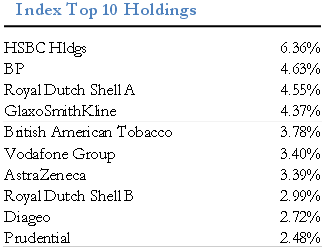
Table Courtesy: Recon Capital