Aided by one of the largest monetary easing programs in the world, Japanese stocks have been among the best developed markets performers over the past several years.
The tumbling yen played a pivotal role in introducing investors to currency hedged exchange traded funds, now one of the fastest growing segments of the ETF market. The WisdomTree Japan Hedged Equity Fund (NYSEArca: DXJ), which has added over $2.9 billion in assets this year, making it one of the top-10 asset gathering ETFs, is now home to $16.4 billion in assets under management. That puts DXJ within striking distance of the iShares MSCI Japan ETF (NYSEArca: EWJ) for the title of largest Japan ETF. [ETFs Add $36.1B in March]
So currency hedging is hot and as U.S. income investors know, so is the concept of dividend growth. The two themes come together in the WisdomTree Japan Hedged Dividend Growth Fund (NYSEArca: JHDG), which WisdomTree (NasdaqGS: WETF) introduced Thursday.
Compared to other developed market destinations, such as the U.S., U.K. and Australia, Japan has a long way to go to prove its dividend mettle. However, the payout situation in historically low-yielding Japan is improving. For example, WisdomTree’s Japan dividend stream last year reached a new high of nearly 8 trillion yen, up 14.6% from the 2008. In dollar terms, the Dividend Stream also reached a new high of $77.2 billion, an increase of 4.5% from the 2012 high, according to WisdomTree.
With the yen falling, Japanese dividend growth is, not surprisingly, being driven by the country’s exporters, which in large part hail from the consumer discretionary sector. The WisdomTree Japan Hedged Dividend Growth Fund allocates over 20% of its weight to discretionary names. Industrials and technology names, export-heavy sectors in their own right, combine for 34% of the new ETF’s weight.
The weights assigned to JHDG’s nearly 250 holdings are “proportional to its cash dividend per share paid over the annual cycle prior to the index screening date multiplied by its shares outstanding, or Dividend Stream, relative to all other Index constituents. Dividends are measured in terms of U.S. dollars, and a company must have paid at least $5 million over the prior annual cycle to be eligible for inclusion,” according to WisdomTree.
Japan’s recent dividend growth trajectory is encouraging. In local currency terms over the past year, the MSCI Japan Index’s dividend growth of 20.2% is well above the 13.3% dividend growth rate on the S&P 500, according to WisdomTree data. That is saying something because in recent years the U.S. has been the dominant developed markets force when it comes to dividend growth.
As is the case with some well-known, U.S.-focused WisdomTree dividend ETFs, JHDG considers return on assets and return on equity as part of its selection criteria.
“Return on equity for the WisdomTree Japan Hedged Dividend Growth Index (10.2%) was slightly higher than it was for the JPX-Nikkei Index 400 (9.5%), but the return on assets (ROA) figure for the WisdomTree Index (3.0%) was about twice that of the JPX-Nikkei Index 400 (1.6%), leading to almost 45% lower leverage. An interesting point on the subject of leverage: the WisdomTree Japan Hedged Dividend Growth Index had less than 4% weight to Financials, whereas the JPX-Nikkei Index 400 had 18.0% weight to this same sector, certainly a notable difference,” said WisdomTree Research Director Jeremy Schwartz in a note out Thursday. [Quality and Dividend Growth in Japan]
JHDG is WisdomTree’s thirteenth currency hedged ETF and the issuer’s ninth Japan fund. The new ETF charges 0.43% per year.
JHDG Top 10 Holdings
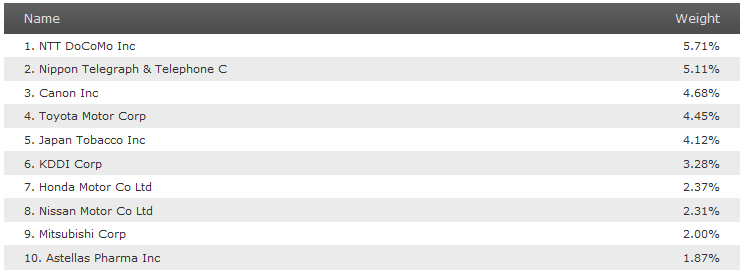
Table Courtesy: WisdomTree