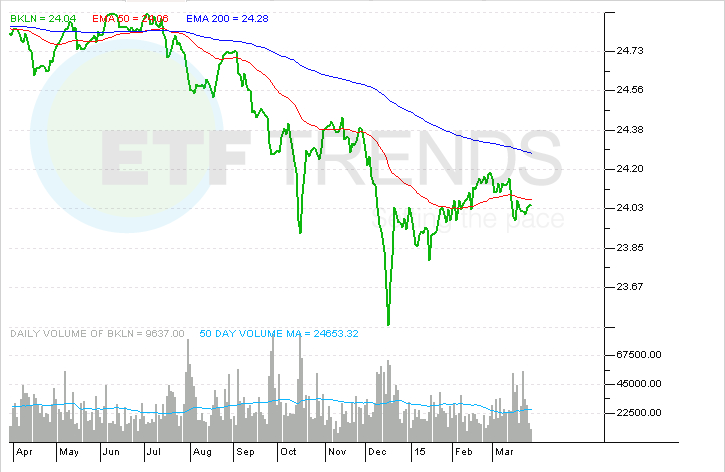
Bank loan, or senior loan, exchange traded funds became a favored asset class for yield-starved investors in recent years, but more recently, well-known bank loan ETFs have suffered outflows as some investors have voiced concerns regarding the underlying liquidity in the senior loan market.
Additionally, some market observers see tighter regulations as potentially crimping the senior loan market. For example, U.S. regulators, including the Federal Reserve and the Office of the Comptroller of the Currency, have revealed new guidance to govern banks’ leveraged lending to contain a potentially overheated credit market. The Fed also confirmed that it will incorporate the guidance in its annual stress test for banks, which would diminish a failing bank’s ability to pay dividends to shareholders. [New Regulations Could Weigh on Bank Loan ETFs]
Still, ETFs such as the PowerShares Senior Loan Portfolio (NYSEArca: BKLN) hold allure for investors, particularly at a time when high-yield energy debt is mostly viewed as unattractive in the face of low oil price and when it is nearly a foregone conclusion that the Federal Reserve will raise interest rates later this year.
Since the senior loans have rates that adjust periodically, the floating-rate loans offer investors an alternative method of earning yields with little or no interest-rate risk. Due to their floating rate component, bank loans are seen as an attractive alternative to traditional corporate bonds in a rising rate environment. Bank loan securities allow their interest rate to shift, or float, along with the rest of the market, whereas a fixed interest rate stays constant until maturity. The $5.43 billion BKLN has an average days to reset of 23.3 with a yield to maturity of 4.82%. [Rising Rates Have Bank Loan ETFs in Focus]
“In a rising rate environment, bank loans have a key advantage over traditional high yield bonds — they are structured with floating rates. This allows their coupons to adjust upward as rates rise, and makes them a potentially attractive source of yield to consider in a rising rate environment. As investors focus on the interest rate exposure of their fixed income investments, bank loans may offer a lower sensitivity to interest rate risk thanks to their lower duration, while providing the potential for attractive income,” said PowerShares Director of Fixed Income Strategy Scott Eldridge in a recent note.
Eldridge also points out that bank loans are typically less exposed to the energy sector than traditional high-yield bonds, a positive trait at a time when fears are still running high that low oil prices with force a spate of defaults among highly leveraged exploration and production companies. [Energy Warnings for Junk Bond ETFs]
“Plunging oil prices may spell trouble for highly leveraged energy companies — financial strain and default risk could be on the horizon for these companies. Bank loans tend to offer far lower exposure to the sector than high yield bonds,” said Eldridge.
BKLN’s 117 holdings feature some energy issues, but the ETF’s overall energy weight is nowhere close to the 15% to 20% found in more traditional high-yield bond funds.
Over the past year, investors have consistently pulled money from senior loan funds, indicating that they did not believe a Fed rate hike was imminent. However, the interest rate outlook is changing and that could lead investors back to BKLN and rival ETFs.
“For investors still unsure if now is the time to get defensive on rates, even a partial rotation out of high yield and into bank loans could capture some of high yield’s gains in recent months while preparing for potential risks ahead,” adds Eldridge.
PowerShares Senior Loan Portfolio