Homebuilder exchange traded funds are capitalizing on the strengthening housing market, low-rate environment for new owners and greater consumer demand for home improvement.
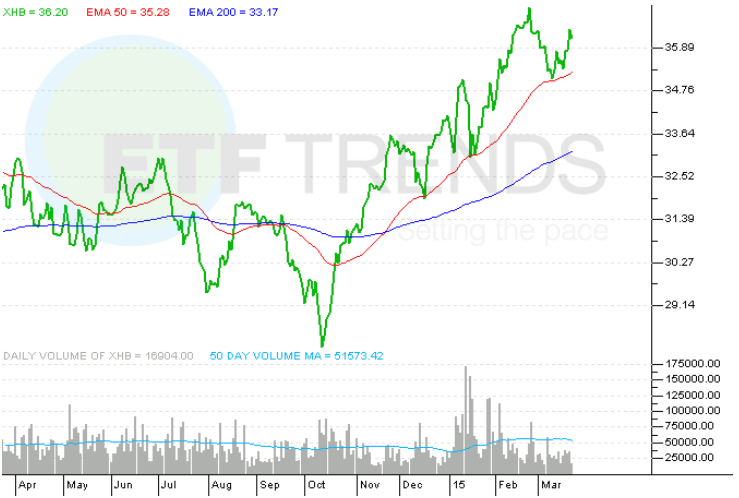
Year-to-date, the SPDR S&P Homebuilders ETF (NYSEArca: XHB) rose 6.2% and the iShares U.S. Home Construction ETF (NYSEArca: ITB) gained 6.7%.
The low-yield environment has made it easier and cheaper for Americans to buy a new home, and the improving economy and lower gas prices have put more money into consumer wallets, which have bolstered home-improvement retailers and other related discretionary stocks.
“Housing is, I think, a wonderfully well-positioned sector,” Todd Gordon of TradingAnalysis.com said in a CNBC article. “Interest rates remain low, and I think that is positive for housing.”
The housing sector may be shedding off the winter freeze with the official start of the spring season as home construction companies offer an optimistic outlook. The positive readings on homebuilders activity suggests that the February housing starts decline was a result of the harsh winter weather, rather than weakness in underlying demand. [Early Spring Numbers Reveal Homebuilder ETFs’ Underlying Strength]
Additionally, the Commerce Department revealed that new home sales in the U.S. unexpectedly jumped 7.8% in February, the most since February 2008, Bloomberg reports.
“It looks like the spring selling season is off to a good start,” Stan Shipley, an economist at Evercore ISI, said in the Bloomberg article. “With low mortgage rates, if you look at it, it’s very affordable for most potential homeowners,” even as credit remains tight.
Along with the direct home construction play, David Seaburg, head of equity sales trading with Cowen & Co., also believes specialty home-improvement retailers are in a good position.
“Home Depot and Lowe’s are the names I would be all over,” Seaburg said in the CNBC article. “I think they are going to continue to move higher. I think you have seen the sweet spot of that market with the reconstruction of houses or the improvement of houses [in the]first leg of the move higher.”
Looking at the homebuilder ETFs, XHB has the largest weights in consumer discretionary names, including 28.7% building products, 15.5% homefurnishing retail, 9.6% home furnishing, 6.3% home improvement retail and 5.9% home appliances. XBH equally weights its holdings and also includes a 3.1% tilt toward Home Depot (NYSE: HD) and 3.2% in Lowe’s Companies (NYSE: LOW).
ITB, on the other hand, leans toward home construction names at 70%, along with 13.3% building products and 8.8% specialty retail.
Alternatively, retailer ETFs may be an unsung play on the homebuilders space as the sector provides indirect exposure to the housing market. For instance, the Market Vectors Retail ETF (NYSEArca: RTH) includes a 8.5% weight in Home Depot and 5.0% in Lowe’s, along with positions in home furnishing retail stores like Target Corp (NYSE: TGT), 3.0% Macy’s (NYSE: M) and 1.6% Bed Bath & Beyond (NYSE: BBBY). [Deflationary Pressures to Support Consumers, Retail ETFs]
SPDR S&P Homebuilders ETF
For more information on the housing market, visit our homebuilders category.
Max Chen contributed to this article.