Master limited partnerships and related exchange traded funds have been pressured along with other energy plays as oil prices fell. However, many may have misconceived notions about how the investments work.
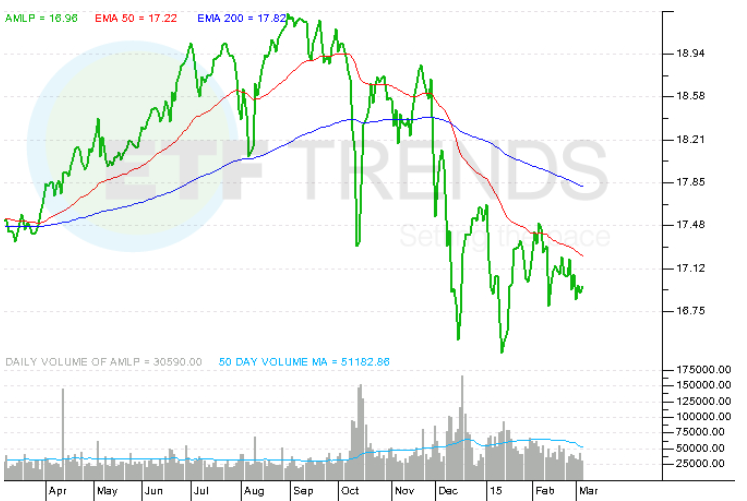
For instance, the JPMorgan Alerian MLP Index ETN (NYSEArca: AMJ) has declined 7.3% and the Alerian MLP ETF (NYSEArca: AMLP) fell 4.0% over the past three months. AMJ and AMLP are the two largest MLP-related exchange traded products on the market. AMJ tracks the Alerian MLP Index, which includes 50 of the largest MLPs, while AMLP tracks the Alerian MLP Infrastructure Index, which includes 25 pipeline and processing MLPs.
“Why so wild in MLP-land?” according to Miller Howard, a money manager that specializes in income=producing stocks, the Wall Street Journal reports. “There are many novice investors in MLPs that don’t really know what they are, what they do, or what the long-term story is. They’re just in it for the yield, or following the ‘hot dot’ of excellent performance for the past decade.”
The previously sturdy First Trust North American Energy Infrastructure Fund (NYSEArca: EMLP), one of the fastest growing MLP ETFs, is off 3.3% over the past month. Last year’s top-performing energy sector ETF, the actively managed EMLP caps its exposure to traditional MLP. That has allowed the fund to be somewhat resilient in the face of declining oil prices while delivering more conventional ETF tax treatment than those MLP funds with C-corporation structures.
Hybrid MLP ETFs, or non-C-corporation MLP ETFs, have reduced direct MLP holdings to under 25% to meet regulatory rules and hold other energy infrastructure stock through subsidiaries as a way to avoid double taxation. [MLP ETF Education]
To qualify as an MLP, the companies pass through at least 90% of their income to investors, making the assets an attractive yield-generating investment. For instance, AMJ has a 3.93% 12-month yield and AMLP has a 6.72% 12-month yield. Additionally, MLPs has shown low correlation to other income assets and the broader equities market. Consequently, the asset class has attracted a large following among income seekers. [How MLP ETFs Work]
Howard argues that many new investors falsely believe that since MLPs are exposed to the energy space, the sector should be sold off when oil prices fall. With MLP-related mutual funds growing to $32 billion in assets from $3 billion over the past four years, Howard points out “that’s a lot of inexperienced investors.”
MLPs don’t make their money based on oil or gas prices. Unlike other energy sector stocks, MLPs primarily deal with the distribution and storage of energy products, so their business model is less reliant on the commodities market since MLPs profit off the quantity of oil and natural gas they are able to move around. Consequently, MLPs act more like energy toll roads. MLPs also operate under very long-term contracts, so any temporary short-term changes in oil or gas typically have little to no effect on revenue streams.
JPMorgan Alerian MLP Index ETN
For more information on master limited partnerships, visit our MLPs category.
Max Chen contributed to this article.