With the dollar soaring against an array of developed and emerging markets currencies, it is not surprising that several of this year’s top asset-gathering exchange traded funds are international funds.
Single-country ETFs have been big parts of the growth experienced by international ETFs trading on U.S. exchanges. Thirty such funds came to market over the past year, bringing the total to 202 with a combined $97.2 billion in assets under management, reports Ashley Lau for Reuters.
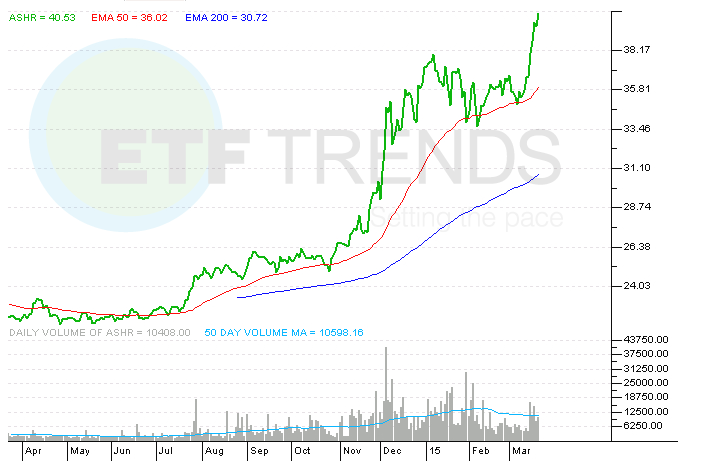
Not all of the top asset gatherings among country-specific ETFs have been currency hedged funds. For example, the Deutsche X-trackers Harvest CSI 300 China A-Shares ETF (NYSEArca: ASHR) has added over $58.4 million in new assets this year. That may not sound like a massive haul, but consider this: ASHR debuted in November 2013 and is already home to nearly $1.1 billion in assets under management, making it the third-largest U.S. listed China ETF.
More importantly, ASHR is up nearly 9%, more than double the returns delivered by the iShares China Large-Cap ETF (NYSEArca: FXI), the largest China ETF trading in the U.S. ASHR hit an all-time high last Friday.
As Reuters notes, investing in international single-country ETFs, particularly the emerging markets funds, is not always a smooth ride. Since most emerging markets are closed while U.S. markets are open, some ETFs can experience noticeable discounts or premiums to their net asset value. For its part, ASHR has confronted another issue: Limited creations.
In three separate instances since the third quarter of 2014, Deutsche Asset & Wealth Management (DAWM), ASHR’s issuer, has been forced to limit creations in the ETF because strong demand forced the fund to bump up against its Renminbi Qualified Foreign Institutional Investor (RQFII), which allows foreign investors to purchase A-shares equities. To its credit, DAWM was able to received increased RQFII quotas in a matter of weeks, enabling it to quickly lift the creation limits. [A-Shares ETF Gets Bigger Creation Limit]
With the CurrencyShares Japanese Yen Trust (NYSEArca: FXY) down 20.6% over the past two years, Japan ETFs have also been prolific asset gatherers. Home to $16.8 billion in assets, the iShares MSCI Japan ETF (NYSEArca: EWJ) is the largest country-specific ETF in the U.S., but EWJ has competition for that title.
After adding adding $2.5 billion to start 2015, a total surpassed by just six other ETFs, the WisdomTree Japan Hedged Equity Fund (NYSEArca: DXJ) now has $15.8 billion in assets. DXJ has outperformed EWJ by two-to-one over the past two years. [Easing Sustains Japan ETFs]
Accomodative monetary policies through Asia and Europe have increased the allure of single-country ex-Japan currency hedged ETFs this year. For example, a recent, surprise interest rate cut by the Bank of Korea triggered staggering asset growth in the Deutsche X-trackers MSCI South Korea Hedged Equity ETF (NYSEArca: DBKO).
At the end of 2014, DBKO was a $5 million ETF. It now has nearly $201 million in assets. Currency hedged Germany ETFs have experienced similar growth trajectories thanks to the weak euro’s positive impact on the export-driven German economy.
With Germany’s DAX being the best developed market equity benchmark in the world this year, the iShares Currency Hedged MSCI Germany ETF (NYSEArca: HEWG), Deutsche X-trackers MSCI Germany Hedged Equity Fund (NYSEArca: DBGR) and the WisdomTree Germany Hedged Equity Fund (NasdaqGM: DXGE) have gone from anonymous to beloved.
DXGE has more than tripled in size this year while DBGR has more than doubled in size, marking the second consecutive year the Deutsche Asset & Wealth Management offering has done so. Solid inflows to hedged Germany ETFs have continued this month, led by almost $248 million in assets flowing into HEWG. DBGR and DXGE have added a combined $177 million since March 1. HEWG is now home to over $1 billion in assets. [Hedged Germany ETFs See Big Inflows]
Deutsche X-trackers Harvest CSI 300 China A-Shares ETF