The Barron’s 400 ETF (NYSEArca: BFOR) and its underlying benchmark, the Barron’s 400 Index (B400), underwent some notable changes at the most recent semiannual rebalancing.
The Barron’s 400 Index “selects the 400 stocks from the MarketGrader U.S. Coverage Universe by using a methodology that selects components based on the strength of their fundamentals in growth, value, profitability and cash flow and then screens such potential Index components for certain criteria regarding concentration, market capitalization and liquidity,” according to issuer data.
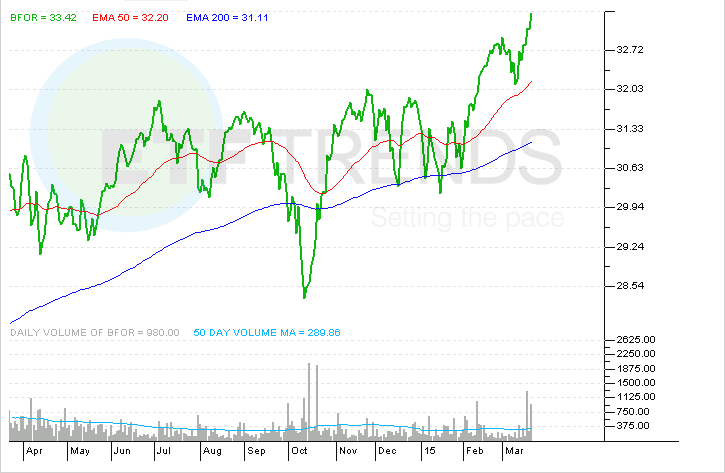
That methodology has spelled success for BFOR. Since the ETF debuted in June 2013, it has surged 35.5%, outpacing the S&P 500 by over 500 basis points along way. Additionally, BFOR has raked in over $300 million in assets, making it one of the more successful ETFs to debut in 2013. [These New ETFs Have Rapidly Gained Assets]
“On a net basis, Health Care showed the biggest increase in sector representation and now accounts for 9.75% of the Index. Technology showed the biggest reduction in sector representation, losing ten companies and now accounting for 12.75% of the Index,” according to a statement.
BFOR, which equally weights its holdings, is home to such big-name healthcare stock as Biogen Idec (NasdaqGS: BIIB), Edwards Lifesciences (NYSE: EW) and Regeneron Pharmaceuticals (NasdaqGS: REGN). [Biogen Boosts Biotech ETFs]
Prominent new additions to BFOR and the Barron’s 400 Index include American Airlines (NasdaqGS: AAL), also a recent addition to the S&P 500, Dow component Johnson & Johnson (NYSE: JNJ), Ameriprise Financial (NYSE: AMP), Celgene (NasdaqGS: CELG) and Starbucks (NasdaqGS: SBUX).
The ETF and the index parted ways with Dow components International Business Machines (NYSE: IBM), McDonald’s (NYSE: MCD) and Verizon (NYSE: VZ) as well as Lowes (NYSE: LOW) and Wells Fargo (NYSE: WFC).
The Barron’s 400 Index “managed to stay out of the ugly financial services names in 2007 and 2008,” said Carlos Diez, CEO and Founder of MarketGrader, in an interview with ETF Trends.
Diez added that the usual turnover for the Barron’s 400 is almost 42%, but the most recent rebalance saw constituent turnover of nearly 39%. The top three most represented sectors – Consumer Discretionary (19%), Financials (20%, the maximum allowed for any sector) and Industrials (19%) – remained the same
Those weights give the Barron’s 400 Index cyclical leverage to the strength of the U.S. economy, said Diez.
Apple (NasdaqGS: AAPL), Chipotle (NYSE: CMG) and Priceline (NasdaqGS: PCLN) are among the 19 companies that have been in the index for at least five years.
The Barron’s 400 Index was introduced by the venerable financial news magazine on the cover of its September 3, 2007 issue. It appears weekly in the magazine’s The Trader column.
Barron’s 400 ETF
Tom Lydon’s clients own shares of Apple. Todd Shriber owns shares of J&J.