Big oil companies may refrain from adding salt into the wounds of energy stock and sector exchange traded fund investors as dividends may remain intact.
“If there was one consistent theme coming from fourth-quarter earnings calls in February and January, it was the sanctity of the dividend. I really don’t think that any of the major oils are going to be cutting their dividends, at least stateside,” S&P Capital IQ’s Stewart Glickman said on CNBC.
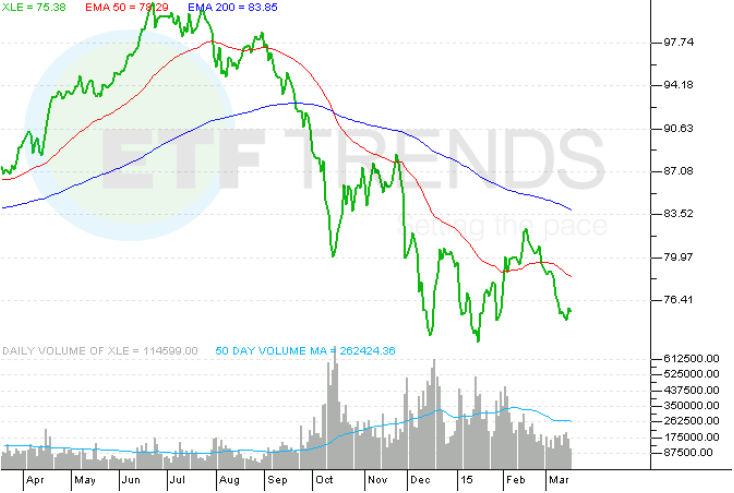
The stable dividend outlook provides a silver lining for energy sector ETFS that have been underperforming in the wake of low oil prices. Year-to-date, the Energy Select Sector SPDR (NYSEArca: XLE) fell 4.8, Vanguard Energy ETF (NYSEArca: VDE) dipped 5.2% and iShares U.S. Energy ETF (NYSEArca: IYE) declined 5.1%.
The energy sector ETFs still offer somewhat attractive yields. For instance, XLE has a 2.35% 12-month yield, VDE has a 1.98% 12-month yield and has a 2.06% 12-month yield.
Looking overseas, though, Italy’s Eni SpA became the first oil major to cut dividends and suspend share buybacks to save funds for future projects, Reuters reports.
Eni is the largest component in the Italy ETF, accounting for 11.5% of iShares MSCI Italy Capped ETF (NYSEArca: EWI).
Oil companies have announced cuts to spending budgets and some have diminished share buybacks in response to a 60% plunge in oil prices since the June high. However, many remain loath to dip into dividends. [Dividend Aristocrats ETFs: Big Oil Payouts Are Still Reliable]
WTI crude oil futures were trading about $42.6 per barrel and touched a six-year low Wednesday while Brent crude oil futures were hovering around $54.3 per barrel. Bentek Energy, a sister firm to S&P Capital IQ, projects WTI crude will average $41 per barrel and potential dip below $40 per barrel this year, but average $48 in 2016.
Rising supply continues to weigh on the oil market. Storage at Cushing, Oklahoma is quickly filling up, with the facility at about 70% capacity, compared to 25% a year ago.
“As long as we stay in contango, and as long as there’s still additional storage capacity to fill, I think those numbers are going to continue to fill and I think it’s going to be keep putting downward pressure,” Glickman added.
Energy Select Sector SPDR
For more information on the energy sector, visit our energy category.
Max Chen contributed to this article.