With bifurcating monetary policies between the U.S. and other developed markets, market observers have been saying global central banks are waging a currency war. Emerging markets cannot be left out of that equation.
Of the more than 20 central banks that have lowered interest rates this year, several are emerging markets and hailing from that group are some of the developing world’s biggest central banks, including the People’s Bank of China (PBOC) and the Reserve Bank of India. Pertaining directly to the PBOC, there is ample speculation that in an effort to defend its exporters, China will not be shy about waging (and winning) a currency war.
Predictably, Chinese policymakers say otherwise and if they are true to their word, some exchange traded funds could benefit. The KraneShares E Fund China Commercial Paper ETF (NYSEArca; KCNY) is one example.
Beijing recently said it supports a “stable” renminbi and its desire to see the Chinese currency become a major global reserve currency.
“Based on the implied support of the government’s leadership, the RMB has reacted with a strong appreciation versus the dollar in recent days,” according to KraneShares, which notes that since recent comments about renminbi stability by Chinese leaders, the currency has gained 1.3% against the dollar.
KCNY, the first Chinese commercial paper ETF to list in the U.S., features an average maturity of just 128 days and a lineup comprised entirely of investment-grade holdings and tracks the CSI Diversified High Grade Commercial Paper Unhedged Index. [Nifty New China Bond ETF]
The Chinese currency is KCNY’s largest holding at 20.6% of the ETF’s weight, according to KraneShares data. The ETF, which debuted in December, can be used in unison with more traditional money market funds to boost a portfolio’s returns and yield profile.
“China’s high money market fund returns are driven from the country’s high risk free rate. China’s yield curve is also very flat and delivers attractive yields relative to US treasuries. A 3mo China government bond delivers 3.39% vs a 3mo US government bond at 0.01%…that’s a 3.38% spread,” KraneShares said in December.
The ChinaBond Commercial Paper Index is up nearly 38% over the past five years compared to a gain of just 1.55% for the S&P US Commercial Paper Index. As the chart below indicates, investors can harness KCNY’s yield advantage without fear of significant downside deviations. [An ETF Alternative to Cash]
Not only is China the world’s third-largest bond market, but its $1.5 trillion corporate bond market is the world’s largest. Chinese companies are expected to absorb a third of global corporate debt needs over the next five years, indicating there could be a robust appetite for ETFs offering exposure to the country’s local commercial paper.
Dollar vs. Renminbi
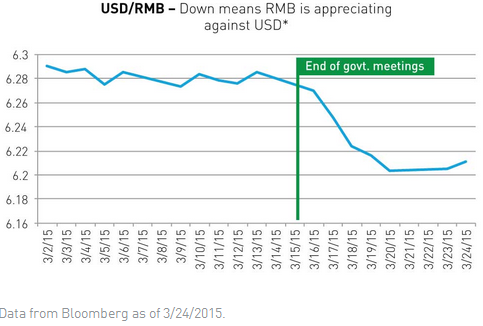
Chart Courtesy: KraneShares