The People’s Bank of China extended its stimulus measures Wednesday, reducing financing costs for businesses and potentially reigniting growth in the economy and country-specific exchange traded funds.
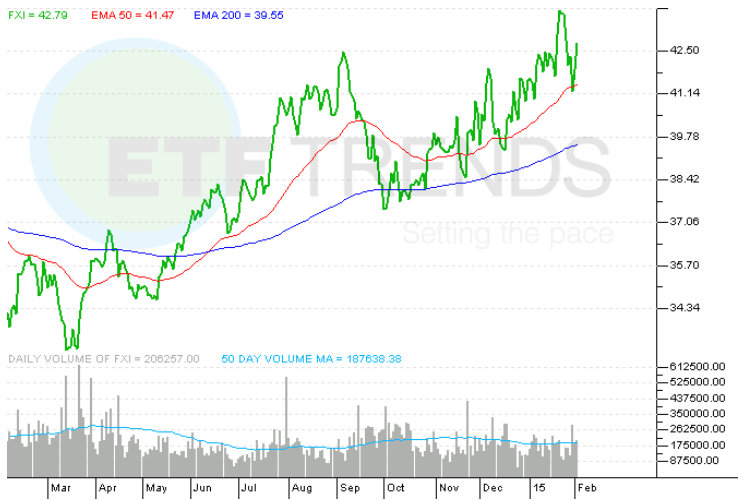
Year-to-date, the Deutsche X-trackers Harvest CSI 300 China A-Shares ETF (NYSEArca: ASHR), which tracks mainland Chinese A-shares, dipped 3.4%, meanwhile, ETFs that track China H-shares have been moving along, with the iShares China Large-Cap ETF (NYSEArca: FXI) up 2.8% and SPDR S&P China ETF (NYSEArca: GXC) 2.3% higher.
The Chinese central bank effectively freed up over $100 billion for greater financing costs for businesses, the first such cut since May 2012, reports Lingling Wei for the Wall Street Journal.
“This is the start of an easing cycle,” one Chinese central-bank official said in the WSJ article.
If businesses bite, financial firms could benefit from the increased lending. The financial sector also makes up a good chunk of the China ETFs, including 48.1% in FXI, 45.5% in ASHR and 32.3% in GXC.
However, some are skeptical about the growth prospects in China and whether or not consumers and companies will take advantage of the loan opportunities to expand.
“We don’t have any plan to expand our business and definitely not going to borrow from banks,” Guo Liyan, owner of Jiangyin Heyuan Textile Co., said in the article. “Business is not as good as before, though unlike my neighboring companies we are still alive. We’re better off keeping things like they are now.”
While the Chinese central bank has been loath to enact loose monetary policies, the PBOC could be reacting to other global central banks’ easing, with some expecting more out of China ahead. [Upside for Bank-Heavy China ETFs]
“We expect at least four more reserve ratio cuts in 2015, in view of the prospect for further deceleration in economic fundamentals,” Shen Jianguang, chief Asia economist at Mizuho Securities Asia Ltd., said in a Bloomberg article, arguing that the rising risk of deflation, weak factory and services readings, and an effective clampdown on stock-market speculation had helped trigger the cut.
Growth slowed to 7.4% in 2014, the lowest level in a quarter century. Economists are slightly pessimistic and widely expect China to lower their annual growth target to 7% this year from 7.5% last year.
The economy has been slowing due to a number of factors, including a slowing property market and greater scrutiny over corruption, which has caused many large companies to delay projects.
iShares China Large-Cap ETF
For more information on China, visit our China category.
Max Chen contributed to this article.