It is not a stunning revelation that the healthcare sector is again a star this year and by the looks of the broad-based strength across exchange traded funds tracking the sector, plenty of investors know this.
On Wednesday, 195 ETFs made all-time highs, 25 of which were healthcare funds. That anecdote should be interpreted as this being the ideal time for investors to blindly buy any healthcare ETF and hope for the best. Rather, ongoing strength for healthcare ETFs puts a premium on studying differences between funds that, by name, appear similar.
With that in mind, we revisit a comparison we highlighted last October between the Health Care Select Sector SPDR (NYSEArca: XLV) and the First Trust Health Care AlphaDEX Fund (NYSEArca: FXH), two of the 25 healthcare ETFs that made record highs Wednesday. [Two Healthcare ETFs: Different and Simiar]
On the basis of a bullish outlook for managed care providers, biotech names and healthcare distributors and a less rosy view of blue chip pharmaceuticals stocks, Ned Davis Research prefers FXH to XLV, reports Chris Dieterich for Barron’s.
The thesis is sound, particularly for the investor seeking reduced pharma exposure. XLV, the largest healthcare ETF by assets, devotes 43% of its weight to pharma stocks, including a combined 24% of its weight to Dow components Johnson & Johnson (NYSE: JNJ), Pfizer (NYSE: PFE) and Merck (NYSE: MRK). Conversely, FXH’s pharma weight is just 14.7%. Merck is not a member of FXH’s lineup while J&J and Pfizer combine for just 2.2% of the ETF. [Behind the Rise of a Strategic Beta Healthcare ETF]
While XLV and FXH are not identical twins, the pair do possess some notable similarities, including 45 overlapping holdings. Eighty percent of XLV’s 56 holdings also reside in FXH while 61% of FXH’s also make a home in XLV, according to AltaVista Research.
One obvious difference between the two ETFs is that XLV is a cap-weighted ETF, ideal for the investor looking heavy exposure to blue chip pharmaceuticals stocks along with some well-portioned biotech and medical device exposure. On the other hand, FXH is one of the jewels of First Trust’s AlphaDEX lineup, a group of ETFs whose holdings are selected based on “growth factors including three, six and 12-month price appreciation, sales to price and one year sales growth, and, separately, on value factors including book value to price, cash flow to price and return on assets,” according to First Trust.
Interestingly, overlap between the two ETFs has modestly increased. When we looked at the two funds in October, the overlap was this: “Eighty percent of XLV’s 55 holdings are found in FXH while 59% of FXH’s constituents also reside in XLV.”
However, the differences between XLV and FXH are enough to be felt in terms of returns. Over the past year, including paid dividends, XLV is ahead of its smart beta rival by 320 basis points. Over the past three years, FXH, with slightly higher volatility, is ahead of XLV by 660 basis points.
XLV vs. FXH
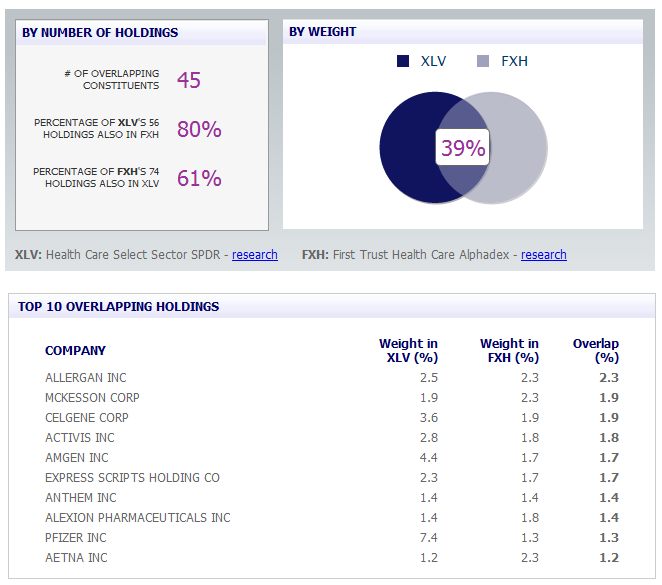
Tables Courtesy: AltaVista Research