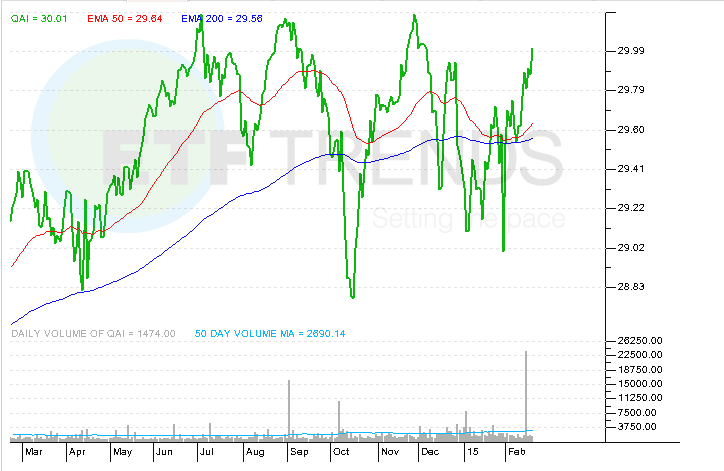
While 2014 was a solid year for U.S. equities and a banner one for U.S. government debt, hedge funds did little to justify the lofty fees charged to clients.
“While 2014 saw some high-profile successes, eVestment estimates of hedge funds’ average gains range from 2.9% to 4.6% for the first 11 months of the year, a period in which the Standard & Poor’s 500 index climbed nearly 12%,” reports Teresa Rivas for Barron’s.
Still, investors are drawn to hedge funds. That includes supposedly savvy institutional investors that should know high fees erode returns over time. Perhaps they could be doing better with one of the exchange traded funds that aim to deliver hedge fund strategies to everyday investors, such as the IndexIQ Hedge Multi-Strategy ETF (NYSEArca: QAI).
QAI, the largest hedge fund strategy ETF, tries to reflect the risk-adjusted return characteristics of hedge funds through various hedge fund investment styles, such as long/short equity, global macro, market neutral, event driven, fixed-income arbitrage and emerging markets. [ETFs a Better way to Hedge Funds]
Obviously, what QAI does is critical information for prospective investors. So is what the fund does not do, meaning this is not one of the guru ETFs that track 13F filings from hedge fund legends, delivering a portfolio of hedge funds’ favorite stocks to regular investors.
QAI is tries to reflect the performance of a customized index that tracks the risk-adjusted return characteristics of hedge funds, writes Corey Hoffstein of Newfound Research for Forbes. The fund uses an ETF of ETFs approach as its marque holdings are other ETFs, including well-known products such as the Vanguard Total Bond Market ETF (NYSEArca: BND) and the PowerShares Senior Loan Portfolio (NYSEArca: BKLN). [Advantages of Alternative ETFs]
Between 2008 and 2014, the alternative mutual funds and ETFs space expanded from 482 products to 1,569, with assets growing to $309 billion from $42.6 billion. QAI is participating in that growth, having topped $1 billion in assets under management earlier this year as the ETF closes in on its sixth anniversary.
Due to the multitude of alternative investment strategies available, advisors and clients should take the time to understand the products before adding them into a diversified portfolio, especially as usage is on the rise. About 60% of advisors allocate between 6% and 20% of assets into these products, pointing to factors like diversification, low correlation, enhanced risk-adjusted profile, absolute returns, poor bond market outlook, investments that clients wouldn’t find themselves and enhanced yield, according to Morningstar.
IQ Hedge Multi-Strategy Tracker ETF